


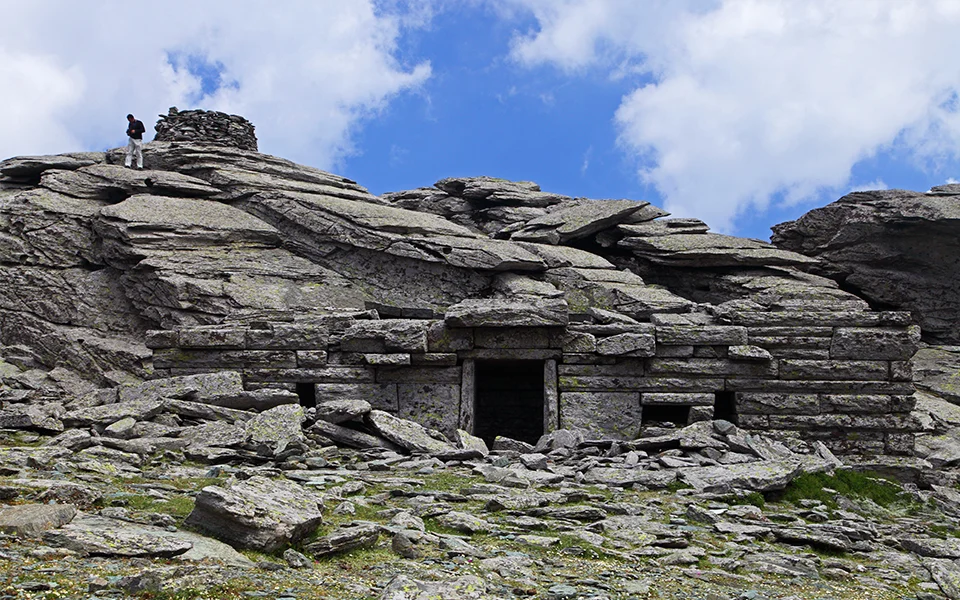
More than twenty mysterious stone structures known as Drakospita, or “Dragon Houses,” dot the rugged mountain peaks of southern Evia near the towns of Styra and Karystos. These squat, slate-gray buildings constructed from massive stone slabs without mortar have puzzled archaeologists and historians for generations. Most scholars believe the Dragon Houses of Evia were built during the Classical or early Hellenistic period, between the 5th and 4th centuries BC, yet their exact purpose and construction methods remain uncertain.
The largest example stands near the summit of Mount Ochi at 1,399 meters above sea level, measuring 12.7 meters by 7.7 meters with walls approximately 1.5 meters thick. British engineer John Hawkins first documented this impressive structure in 1820, noting its entrance crowned by a single horizontal slab nearly four meters long and weighing an estimated ten tons.
Ancient Engineering Without Modern Tools
The Dragon Houses display deceptively simple yet sophisticated construction techniques. Rectangular in plan and built from massive slabs of local Karystian stone, these structures rise directly from bedrock without visible foundations. No mortar binds the stones together; instead, the sheer weight of each block holds the structure in place while smaller stones are carefully inserted to stabilize the walls.
Their most distinctive feature is the corbelled vault roof system. Huge stone slabs are laid in successive horizontal courses, each projecting slightly inward from the one below until the opposing walls converge in a steep pyramidal form. A narrow slit at the apex allows light and possibly smoke to filter through, while monolithic jambs and lintels frame the entrances.
Local folklore attributes their construction to beings of superhuman strength, reflecting the word “dragon” in earlier Greek tradition, which could refer to creatures possessing extraordinary power. However, the structures demonstrate careful planning and engineering skill rather than mythical intervention, remaining largely intact despite centuries of wind, rain, and seismic activity.
Limited Archaeological Evidence Complicates Dating
Unlike most ancient Greek monuments, these stone buildings offer few textual clues about their origins or purpose. No dedicatory inscriptions have been found in their original locations, and their stark architectural form resists easy stylistic classification within known Greek building traditions.
In 1959, Professor Nikolaos Moutsopoulos excavated the Mount Ochi structure, uncovering pottery sherds, animal bones, and faint traces suggesting possible sacrificial activity, according to archaeological reports. One fragment reportedly bore an inscription, though its interpretation remains uncertain. The finds are now housed in the Archaeological Museum of Karystos.
Based on ceramics and construction techniques, along with comparisons to stone houses found elsewhere around the Mediterranean, many scholars tentatively date the buildings to the Classical and early Hellenistic periods. Additionally, some researchers have suggested slightly earlier or later chronologies, but without definitive evidence, the structures hover within a broad historical timeframe.
Competing Theories About Function and Purpose
One longstanding theory proposes that the ancient stone structures functioned as rural sanctuaries, possibly dedicated to Zeus or Hera. Their commanding positions perched on ridges overlooking valleys and sea routes support this interpretation. Ancient myth associates Mount Ochi with the sacred marriage of Zeus and Hera, and at least one ancient source mentions a temple to Hera in the region.
Meanwhile, the buildings lack sculptural decoration, altars, or architectural flourishes typical of known Greek temples. If they were religious sanctuaries, they were remarkably austere compared to other sacred sites from the same period.
Other interpretations view them as components of agricultural estates or quarrying operations. The well-preserved complex at Palli-Lakka near Styra consists of three rectangular buildings grouped together, suggesting organized rural activity. Southern Evia was historically associated with quarrying Karystian stone used extensively in Imperial Rome, leading some researchers to propose the structures served as storage facilities or worker shelters.
In contrast, military explanations have also been advanced, with scholars suggesting their elevated locations and substantial walls imply defensive or lookout functions. A tower-like example at Niborio near Styra has been interpreted as a watch post, while others favor more practical seasonal uses for shepherds or workers navigating mountainous terrain.
Accessing the Mount Ochi Dragon House
The most impressive Dragon House can be reached by hiking to the peak of Mount Ochi, a trail leading through forests and opening onto sweeping views across the southern Evian Gulf. The path begins near the chestnut forest of Kastanologos and passes the Ochi refuge at 1,050 meters, currently awaiting restoration according to local reports.
Karystos serves as the practical base for exploring these ancient mysteries, with ferries connecting the town to Rafina on the Attic coast. From there, visitors can venture to various Dragon House sites scattered across the region’s protected Natura 2000 landscape.
Further archaeological investigation and analysis may eventually provide more definitive answers about the construction timeline and original function of these enigmatic structures. However, scholars acknowledge that without significant new discoveries or evidence, the Dragon Houses will likely continue to resist simple explanations.

Follow Live Media News on Google News
Get Live Media News headlines in your feed — and add Live Media News as a preferred source in Google Search.
Stay updated
Follow Live Media News in Google News for faster access to breaking coverage, reporting, and analysis.
- Search any trending topic on Google (for example: Greece news).
- On the results page, find the Top stories section.
- Tap Preferred sources and select Live Media News.