


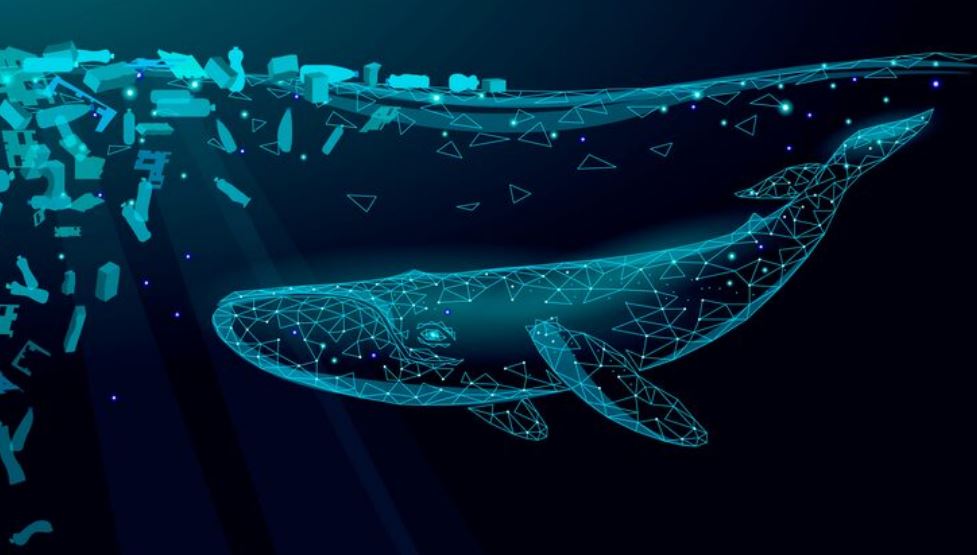
The Caribbean Sea appears nearly glassy at dawn off the coast of Dominica, broken only by the sporadic ripple of giant surfacing. With its crew leaning over railings and their headphones pressed firmly to their ears, a research vessel floats silently. The ocean starts to speak in clicks as a hydrophone beneath the hull listens.
For many years, scientists believed that sperm whales were communicating in ways that were much more intricate than previously thought. However, artificial intelligence has only lately started to show the depth of that discussion. Marine biologist David Gruber founded the multidisciplinary Project CETI, which is in charge of the endeavor. Their objective is surprisingly straightforward: to comprehend what whales are saying.
| Category | Details |
|---|---|
| Research Initiative | Project CETI |
| Founder | David Gruber |
| Focus Species | Sperm Whales (Physeter macrocephalus) |
| Key Technology | Artificial Intelligence, Machine Learning, Hydrophones, Drones |
| Research Location | Dominica, Caribbean Sea |
| Notable Discovery | Identification of structured whale “codas” resembling linguistic patterns |
| Reference Website | https://www.projectceti.org |
Naturally, the task is extremely difficult. Sperm whales use a series of quick clicks called codas, which are rhythmic patterns created deep within their enormous heads, to communicate. Sharp and metallic, the sounds resemble underwater Morse code to human ears and reverberate through headphones with eerie clarity. Researchers manually cataloged these clicks for years, sorting through countless hours of recordings with little discernible significance.
The pace was altered by artificial intelligence. Thousands of hours of audio data are now analyzed by machine learning algorithms, which can detect minute changes in rhythm, tempo, and structure. These codas are not random, according to researchers; rather, they follow identifiable patterns that resemble phonetic building blocks. Whales may have an acoustic “alphabet,” a communication system developed over millions of years of evolution.
As this develops, it seems as though science is edging closer to a boundary that was previously only accessible through myth. Humans have separated themselves from other species for centuries, claiming that language is exclusively ours. That presumption is starting to appear shaky.
Technology has come a long way, as demonstrated by the work being done in Dominica. Hovering over whale pods, drones record synchronized footage while sensors affixed to the animals capture movement and vocalizations. Every data point is fed into AI models that can reliably identify patterns that the human ear cannot. In certain instances, the algorithms are remarkably accurate at predicting the subsequent click in a series.
Deciphering meaning, however, is a different story.
Whether these vocalizations directly relate to ideas, feelings, or social structures is still up for debate. Certain codas seem to serve as names for members of close-knit matrilineal groups. Others might strengthen social ties or indicate coordination during deep-sea hunting expeditions. Sperm whales live in a world that is characterized by sound, and in the dark depths of the ocean, sound travels faster and farther than light.
Beyond marine biology, there are wider ramifications. AI has the potential to change how humans perceive intelligence in general if it is successful in deciphering cetacean communication. Whales have the biggest brains on Earth, with intricate social structures and cultural behaviors, as researchers have long known. Language could now be added to that list.
The research has a philosophical undertone as well. Gruber and other scientists place a strong emphasis on empathy, treating whales as participants in a conversation rather than as subjects. This viewpoint is becoming more popular in ethical and legal circles, where proponents contend that comprehending whale communication could bolster demands for greater rights or protections for nonhuman animals.
It’s difficult to ignore how technology, which is frequently held responsible for separating people from nature, is actually bringing us closer to it. The same algorithms that produce human language are now patiently listening to the deep. Linguists and computer scientists work with marine biologists in labs from Massachusetts to Oxford, trying to translate a language molded by time, darkness, and pressure.
However, skepticism is still beneficial. Translating whale communication into human language runs the risk of oversimplifying a system that was developed for a completely different sensory environment. Whales do not use the same vocabulary or grammar as people. Rhythm, vibration, and context are all ingrained in their language, if it can be called that. Projecting human meaning onto something essentially alien is always risky.
Nevertheless, there is no denying progress. AI has already identified subtle coda variations that resemble regional accents, as well as dialects among whale populations. Similar to musical ornamentation, researchers have found patterns that may convey subtle information through minute changes in timing or pitch. These findings point to a level of complexity that was previously unthinkable.
The narrative recalls a time in the 1970s when humpback whale song recordings enthralled listeners and contributed to the global Save the Whales movement. The public’s perception was altered at the time by hearing whale voices. These days, comprehending those voices could strengthen that change, turning curiosity into a connection.
The research ship keeps up its silent watch as the sun rises above the Caribbean horizon. The headphones are filled with a burst of clicks, silence, and then another rhythmic exchange from below. A slow and painstaking effort to translate the oldest conversations from the ocean, each sequence adds a new layer to an expanding digital lexicon.
It’s unclear if humans and whales will ever have a genuine conversation. However, a significant event is already taking place. Where humans once only heard noise, machines are listening, uncovering patterns concealed by waves and centuries of miscommunication.
Whale language is no longer a mystery lurking in the shadows thanks to that silent conversation between technology and the deep. One click at a time, it is developing into a tentative, unfinished, and profoundly humbling conversation.

Follow Live Media News on Google News
Get Live Media News headlines in your feed — and add Live Media News as a preferred source in Google Search.
Stay updated
Follow Live Media News in Google News for faster access to breaking coverage, reporting, and analysis.
- Search any trending topic on Google (for example: Greece news).
- On the results page, find the Top stories section.
- Tap Preferred sources and select Live Media News.