


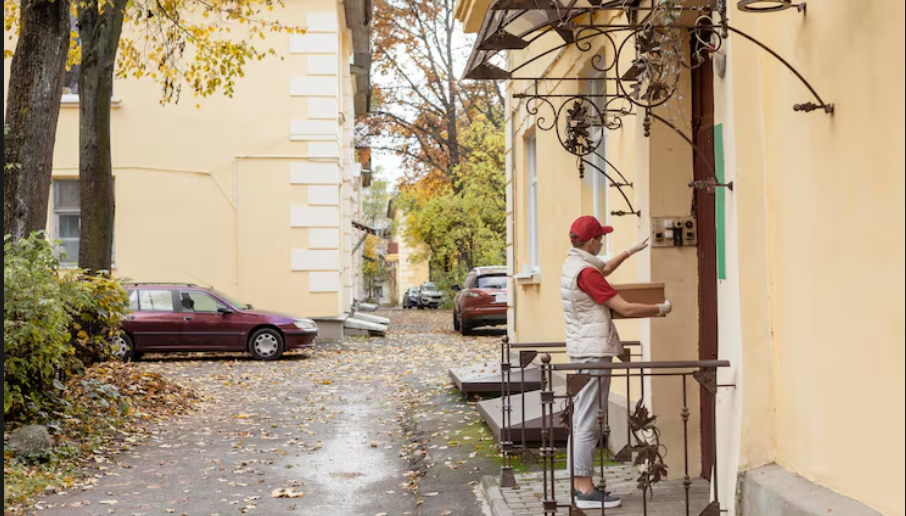
It’s not the first thing you see on Koukaki’s main business street. It is what isn’t. A bakery that used to smell like butter at seven in the morning, a barber whose chair has been vacant for more than a year, and a small grocery store whose owner used to know everyone’s names but now knows hardly anyone are all whitewashed windows. The Acropolis, located two kilometers north, draws record numbers of visitors. There is a different kind of silence down here.
Giorgos Prasinoudis, 65, is sipping coffee from a paper cup while sitting on the sidewalk outside his former motorcycle repair shop. The window’s For Sale sign has started to curl around the edges. For thirty-two years, he oversaw the establishment. His wife and 11-year-old daughter are currently in Germany, he says with a flat kind of resentment that only comes from people who have given up trying to defend themselves. “It’s over for Greece,” he declares. “We won’t recover for another 50 years.” It’s the kind of statement that seems exaggerated until you see the street he’s referring to.
| Neighborhood | Koukaki, central Athens |
| Distance from city center | Roughly 2 kilometers south of downtown |
| Nearest landmark | Acropolis and the Acropolis Museum |
| Country | Greece, population ~10.4 million |
| Period of decline observed | 2010–present, accelerating after 2015 capital controls |
| Reported retail closures nationally | ~85,000 retailers since first bailout |
| Sector income loss | 45% (National Confederation of Greek Commerce) |
| Unemployment at peak | Over 25% overall, 50%+ for those under 25 |
| Recent retail turnover drop | 10.9% year-on-year (per ELSTAT) |
| Notable parallel streets | Aghiou Meletiou, parts of Halandri, Maroussi, Kolonaki |
Speaking with people here gives me the impression that something was meant to save Koukaki. Perhaps tourism. The wave of Airbnb. International magazines continued to write about the post-pandemic surge. Indeed, in certain areas, such as the cafés close to the metro station, foreign couples passing through with rolling suitcases, and a few boutique hotels that seem to have sprung up overnight. However, the side streets have not yet experienced this prosperity. It’s odd to observe. Despite having the same postal code, two economies are unwilling to interact.
In simpler terms, Costas Kitsos, the proprietor of a hardware store a few blocks away from the closed repair shop, describes it. People enter, inquire about the cost of a small item, such as a hinge or a piece of pipe, and then leave. “Everyone is scared to spend money because they don’t know what will happen,” he states. Technically, the 2015 capital controls are no longer in effect. It’s not the fear they bred. An economy based on cash payments doesn’t easily forget that it can only have 60 euros per day, and cash still feels valuable.
A portion of the story is revealed by the numbers. In one recent comparison, retail turnover, excluding fuel, decreased by about 10.9%. Since the initial bailout, about 85,000 retailers have failed, and the industry has lost almost half of its revenue. However, statistics don’t fully account for why this neighborhood in particular hasn’t recovered as well as Koukaki’s tourist-oriented streets. Rents that decreased but not sufficiently, a building stock left over from postwar reconstruction that no one quite knows what to do with, and a generation of small shopkeepers too young to retire and too old to retrain could all be dull, structural answers. It’s also possible that the more unsettling solution is that Athens is actually recovering, albeit unevenly in ways the city hasn’t fully considered.
Quietly, real estate analysts have warned that entire commercial strips may go dark. About half of the shops on Aghiou Meletiou Street, which is located between Acharnon and Patission, have already closed. Halandri Maroussi is mentioned. Even fragments of Kolonaki, which used to appear impervious to everything. Even though the nearby Acropolis Museum breaks attendance records every season, Koukaki fits the pattern. As you pass Prasinoudis’s closed store with its faded kid’s drawings still affixed to the interior wall, you get the impression that something was overlooked. Not by coincidence, precisely. It was more like this street wasn’t on the recovery’s path.
In Greece’s protracted crisis narrative, it’s difficult to ignore how frequently the headline figures rise while the reality on the ground stagnates. By most accounts, Athens is having its moment. Hotels are packed. Galleries are open every month. In a few years, the reconstruction of the southern coastline may resemble a completely new city. However, two kilometers away from the nation’s most photographed landmark, there are still locations where a shop sign flapping in the wind is the loudest sound on a Wednesday afternoon. Nobody in Koukaki seems willing to publicly address the question of whether the next wave reaches them or passes around them once more.

Follow Live Media News on Google News
Get Live Media News headlines in your feed — and add Live Media News as a preferred source in Google Search.
Stay updated
Follow Live Media News in Google News for faster access to breaking coverage, reporting, and analysis.
- Search any trending topic on Google (for example: Greece news).
- On the results page, find the Top stories section.
- Tap Preferred sources and select Live Media News.