


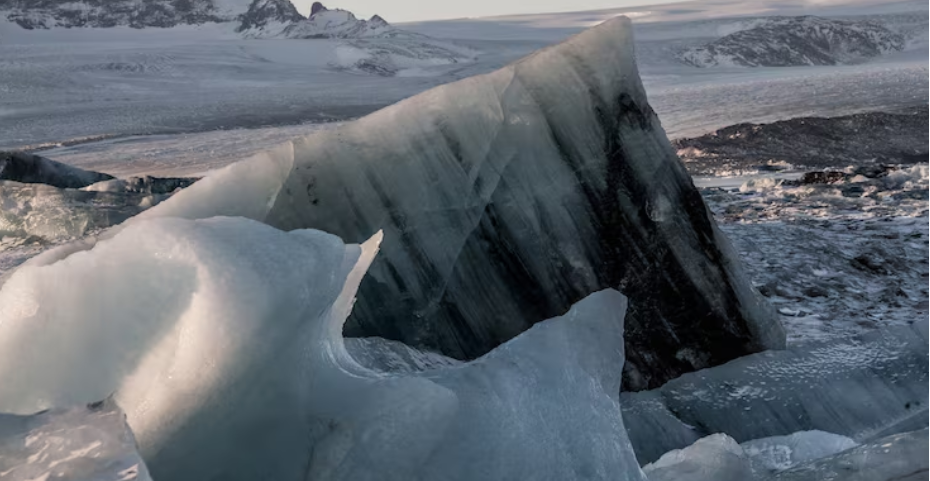
It doesn’t appear that the camp at Crary Ice Rise is on the front lines of a global reckoning. A motley assortment of yellow tents. Out of the white silence, a drilling tower rose. It feels almost artificial to feel the wind skimming across a flat surface of ice. However, a team led by Imperial College London has discovered something that feels more like a verdict than sediment under 523 meters of frozen water.
The longest core ever recovered from beneath an Antarctic ice sheet is the 228-meter core they took out. Just that fact is significant. The mud’s contents, however—shell fragments, marine microfossils, and gravel left over after ice was ground—are what really make this accomplishment stand out. What they have recovered might be the most truthful climate witness we have seen in a long time.
| Project Name | SWAIS2C (Sensitivity of the West Antarctic Ice Sheet to 2°C) |
|---|---|
| Lead Institution | Imperial College London |
| Key Site | Crary Ice Rise |
| Ice Thickness Drilled | 523 metres |
| Sediment Core Length | 228 metres |
| Estimated Record | Up to 23 million years |
| Ice Sheet in Focus | West Antarctic Ice Sheet |
| Sea Level Potential | 4–5 metres if fully melted |
| Reference | https://www.imperial.ac.uk |
There is enough frozen water in the West Antarctic Ice Sheet to cause a four to five meter rise in sea levels worldwide. For decades, scientists have been aware of that. They don’t precisely know how quickly that mass shifts from stability to retreat. The 1.5–2°C warming threshold is set by the Paris Agreement. However, it’s still unclear if West Antarctica is protected by that threshold or if it just postpones the inevitable.
Before lowering steel pipe into ancient sediment, the SWAIS2C team used hot water to drill through half a kilometer of ice while standing on the Ross Ice Shelf, hundreds of kilometers from the closest station. There’s a sense that every meter recovered was both a technical victory and a risk when watching footage of the drill string plunging into darkness. There had been two failed seasons. The equipment became stuck. Flights were halted by weather. There was a “boom or bust” element to this third attempt.
It must have seemed unreal when the first core sections appeared, three meters at a time, covered in mud older than man. Layers rich in gravel indicated times when the ice sheet was grounded and weighed down over the location. Then came shells and fine muds. tiny algae fossils that were found only in open waters. The tone is altered by that particular detail.
because Crary Ice Rise is located close to West Antarctica’s center. The fact that that location was once under open water indicates that the ice sheet moved far inland during warmer periods. Not in the periphery. Not merely thinning. Retraction. The image of the dark, moving sea in place of the continent’s frozen heart is unsettling.
According to preliminary dating, the core is 23 million years old. This includes times when global temperatures were higher than they are now, and perhaps higher than what is anticipated for 2100 under the policies in place. It appears that investors think adaptation funds and sea walls can control the risk. From Miami to Mumbai, the coastal real estate markets are still booming. However, this core suggests that the ice does more than just negotiate when it is warm for an extended period of time. It pulls away.
In order to improve timelines and match sediment layers to particular climate intervals, scientists like Dr. James Marschalek and associates will now test isotope signatures. Future sea level rise projections from computer models will be compared to this physical record. That tightens forecasts, theoretically. In actuality, it might increase the margin of concern. due to the fact that models can be adjusted. Mud can’t.
Geological evidence has a rawness to it that makes it more difficult to spin. Ice grinding forward is suggested by gravel embedded in compacted layers. Absence is suggested by marine fossils. Compared to the static white maps found in textbooks, the alternation depicts a more dynamic system of advance and retreat.
It’s difficult to ignore the timing. A 23-million-year archive arrives silently in refrigerated containers, shipped via New Zealand for analysis, while corporations publish carefully worded sustainability reports and policymakers debate incremental emissions cuts. No news reports about quarterly profits. Only sediment.
This is economic news, though. Tens of millions would be displaced, ports, insurance markets, entire cities, and coastlines would be redrawn if the sea level rose by four meters. It’s hard not to notice the contrast when you watch the drill team struggle with equipment in freezing fog: a great deal of physical effort is required to extract a warning that the rest of us may still consider abstract.
Additionally, there is uncertainty. It is unknown exactly what temperature threshold caused previous retreats. Predictions are complicated by feedback loops, such as grounding lines rising from bedrock and warming oceans eroding ice shelves. The current topography and current configuration may cause collapse to occur more slowly. We might also be underestimating the momentum that is already developing beneath the ice.
In recent decades, the mass loss of the West Antarctic Ice Sheet has accelerated. Grounding lines are retreating and edges are becoming thinner, according to satellite data. Satellites, however, only record the present. By extending the story backward, this core reveals that the system has previously flipped. History is important. It does this by limiting the comfort zone, not because it ensures repetition.
The drillers at Crary Ice Rise were concerned about every recovery meter. A cable broke. a blocked borehole. The weather is getting better. The operation’s vulnerability is somewhat akin to that of the ice sheet itself—stable until it isn’t.
From above, Antarctica continues to appear eternal. Never-ending white. However, beneath that surface, there is proof that an ocean once lapped where the ice is today. A prophecy written in bold ink is not found in the deepest rock core. It is more nuanced. layered. uneven. When taken seriously, however, it reads like a toothy forecast. It’s unclear if we should ignore it or bite down on it.

Follow Live Media News on Google News
Get Live Media News headlines in your feed — and add Live Media News as a preferred source in Google Search.
Stay updated
Follow Live Media News in Google News for faster access to breaking coverage, reporting, and analysis.
- Search any trending topic on Google (for example: Greece news).
- On the results page, find the Top stories section.
- Tap Preferred sources and select Live Media News.