


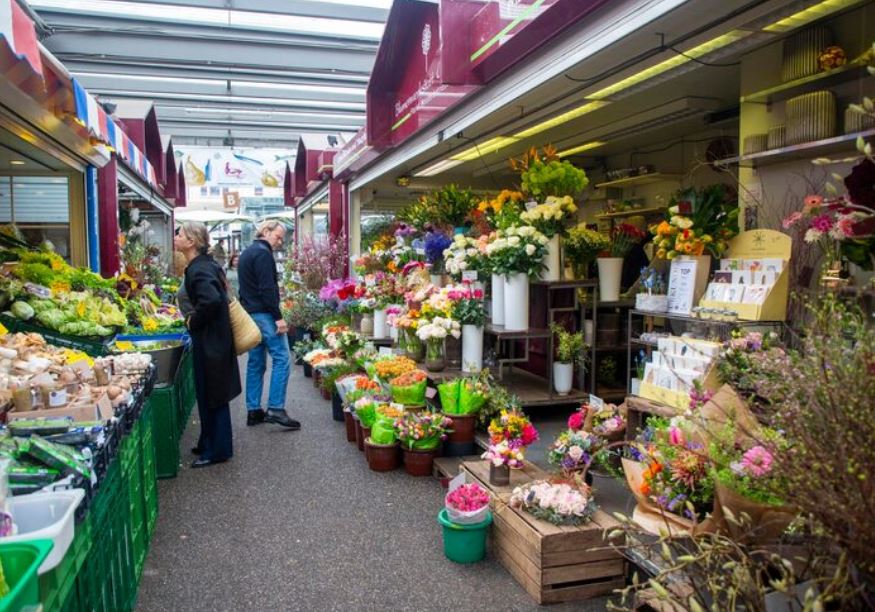
A grand opening has a certain atmosphere, and Harvest Market on April 15 had it all. Long before ten in the morning, people were waiting in line outside the entrance of 910 Briarwood Circle. stroller-using parents. students at universities. retirees. The crowd from Ann Arbor is the type that inquires about the origin of the tomatoes before examining the cost. By midday, the aisles inside were a slow-moving river of customers attempting to take in 57,000 square feet of something that was both familiar and completely unfamiliar to the neighborhood.
Niemann Foods, an Illinois-based Midwestern grocery store with locations in Springfield, Champaign, and Carmel, owns Harvest Market. Its first store in Michigan is in Ann Arbor. That particular detail is more important than it seems. The same few brands—Kroger, Meijer, Busch’s, Whole Foods, and Trader Joe’s—have dominated Michigan’s grocery market for decades, and any newcomer must balance being both ambitious enough to stand out and recognizable enough to draw repeat business. Employee-owned Harvest Market has attempted to do both, and the first week of business indicated that it might succeed.
| Detail | Information |
|---|---|
| Store Name | Niemann Harvest Market |
| Address | 910 Briarwood Circle, Ann Arbor, MI 48108 |
| Location Anchor | Briarwood Mall, near I-94 |
| Grand Opening | April 15, 2026 |
| Size | ~57,000 square feet |
| Parent Company | Niemann Foods, Inc. |
| Other Locations | Springfield IL, Champaign IL, Carmel IN |
| First Michigan Store | Yes |
| Ownership Structure | Employee-owned |
| Store Hours | 7:00 AM – 9:00 PM, daily |
| Phone | 734-436-1991 |
| Key Departments | Butcher, seafood, cheese, scratch bakery, produce, coffee |
| Specialty Features | Butter Room, Farmhouse Restaurant, bar, salad bar, ice cream, bulk section |
| Additional Amenities | Co-working space, free Wi-Fi, learning center, balcony seating |
| Competing Nearby Grocers | Whole Foods, Kroger, Meijer, Busch’s, Plum Market, Trader Joe’s |
| Previous Tenant in Retail Ecosystem | Replaced gap left by Lucky’s Market closure |
| Online Presence | Birdzi-powered mobile app |
The scale hits first when you walk in. Hand-cut meats, including some exotic ones, on a butcher counter. More seafood than most Ann Arbor customers have seen outside of downtown Detroit. A cheese department where real artisan wheels are on display like miniature sculptures. A scratch bakery producing macarons and loaves. Then, rather strangely, there is a Butter Room (yes, butter is made in-store), a coffee shop, an ice cream shop, a sit-down restaurant called Farmhouse, a real bar with beer and cocktails, bulk bins of grains and candies, and a second-floor seating area with an outdoor balcony. Additionally, there’s a co-working space with Wi-Fi and a learning center for cooking classes, which make more sense the longer you look.
Early internet reviews have been conflicting, as only Ann Arbor can be. Reddit users praised the prepared foods and local sourcing, including dairy in glass bottles, Michigan-grown produce, and locally produced butter, calling it the nicest supermarket they had ever entered. Others noted that the aisles are so small that a single stopped cart can cause a traffic bottleneck. Some items are clearly marked down for the grand opening, such as bell peppers at 50 cents, heirloom tomatoes at $1 per pound, and Spindrift cases at $3.99. Prices appear to fall somewhere between Kroger and Plum Market. Locals frequently ask one another if those prices will remain the same after the first month of business.
A certain void left by Lucky’s Market’s closure a few years ago seems to be filled by Harvest Market’s arrival. For anything beyond necessities, residents of Pittsfield Township and southern Ann Arbor have been traveling to Whole Foods or Busch’s. A neighborhood’s rhythm is altered by having a fully functional grocery store that can also be used for eating dinner, getting coffee, or using a laptop upstairs. What happens to the smaller players, such as Produce Station, Kerrytown Market, and Argus Farm Stop, is the question. These stores rely on the same clients that Harvest Market is currently pursuing. Online, a few regulars have already been urging one another to continue dividing their allegiance.
The amount of ambition that has been put into a grocery store attached to a failing mall is difficult to ignore. Like the majority of American shopping centers, Briarwood has spent years trying to find relevance. It is a very 2026 solution to bring in a destination-grade grocery store, which people actually drive across town for. It’s unclear if it will be effective in the long run. Right now, it’s evident that Ann Arbor has a new kind of place to spend an hour, and that’s not insignificant for a city that values its cuisine.

Follow Live Media News on Google News
Get Live Media News headlines in your feed — and add Live Media News as a preferred source in Google Search.
Stay updated
Follow Live Media News in Google News for faster access to breaking coverage, reporting, and analysis.
- Search any trending topic on Google (for example: Greece news).
- On the results page, find the Top stories section.
- Tap Preferred sources and select Live Media News.