


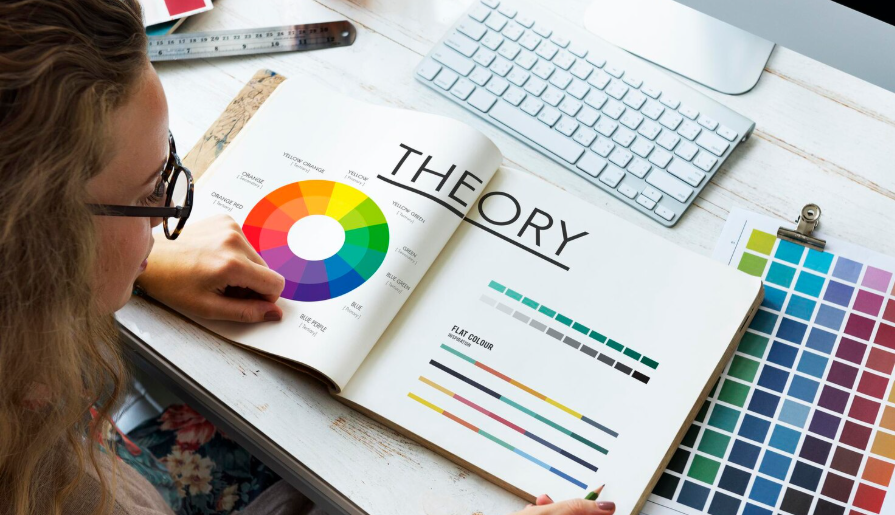
It starts with an almost comical absence: a line that nobody had ever really defined but that everyone assumed existed. Erwin Schrödinger proposed in the 1920s that color perception could be represented as a curved three-dimensional space. Schrödinger is more famous for a thought experiment in which he showed a cat suspended between life and death. He maintained that hue, saturation, and lightness were characteristics arising from the geometry of human vision itself rather than being cultural or linguistic constructs. Like a compass without north, the concept persisted for decades, elegant but unfinished.
While working on visualization algorithms at Los Alamos National Laboratory, a group under the direction of Roxana Bujack discovered something disturbing in a windowless office almost a century later. Colors that should have behaved predictably did not. The differences were mathematical, not aesthetically pleasing. Screens displayed gradients that looked slightly “off,� and simulations revealed tiny but persistent mismatches. It’s possible that most users would never notice. It was engineers.
| Category | Details |
|---|---|
| Original Theorist | Erwin Schrödinger |
| Modern Lead Researcher | Roxana Bujack |
| Research Institution | Los Alamos National Laboratory |
| Scientific Fields | Color perception, geometry, visualization science |
| Core Concept | Hue, saturation, and lightness emerge from geometric structure of color space |
| Key Mathematical Advance | Neutral axis defined using non-Riemannian geometry |
| Major Application Areas | Scientific visualization, imaging, displays, sensors, data interpretation |
| Presented At | Eurographics Conference on Visualization |
| Reference | https://www.lanl.gov |
Schrödinger’s model was the source of the error. The grayscale line from black to white served as the neutral axis for his definitions, but he never provided a mathematical definition for it. The geometry of color had no real origin point without that reference. Consider using a map to measure distances without knowing where zero starts. The system functions, but uncertainty creeps in.
In order to fill that gap, the Los Alamos team moved beyond conventional Riemannian geometry and into a more adaptable mathematical framework. According to their research, the color metric’s internal geometry alone can be used to determine the neutral axis. In other words, gray is structurally ingrained in the way that vision arranges color; it is not a cultural consensus. There’s a quiet boldness in that claim.
In order to form a natural three-dimensional color space, human vision depends on three different types of cone cells that are sensitive to red, green, and blue wavelengths. Mathematician Bernhard Riemann suggested in the 19th century that perceptual spaces might not be flat but rather curved. This curved framework was adopted by Schrödinger, but the geometry has only recently been fully defined. This intellectual thread’s progression from 19th-century mathematics to contemporary visualization labs lends the narrative an odd sense of coherence, as though concepts were just waiting for the appropriate instruments.
The Bezold–Brücke effect, a peculiarity of perception in which the perceived hue changes as brightness increases, was also discussed by the team. They determined the shortest routes, or geodesics, within curved space rather than charting color changes as straight lines. Brighten a deep blue, and it seems to drift toward violet. This adjustment may sound abstract, but it makes sense in practice. Our eyes demand it.
This piece seems to push color away from feeling and toward quantification. When color is used in control rooms, medical imaging, climate modeling, or national security simulations, ambiguity is not charming—it is dangerous. Exaggerated differences in a heat map can be misleading. A diagnosis may be distorted by a display that is not properly calibrated. For a long time, engineers have struggled with these nuances, frequently using approximations.
The speed at which this improved geometry will be able to meet industry standards or consumer screens is still unknown. It can take a while to go from conference paper to worldwide implementation due to committees and compatibility issues. Yet investors and technology firms tend to pay attention when measurement becomes more reliable. Improved color consistency lowers error, which in turn lowers cost.
The study also casts doubt on the widely held belief that language or culture have the biggest influence on how people perceive color. The results imply that hue, saturation, and lightness—the categories we employ—come from the structure of vision itself. That reframes the foundation but does not eliminate cultural nuance. It’s difficult to overlook how this connects science and common sense: debates about whether a blue leans purple might be more a reflection of geometry than opinion.
Outside the lab, the implications feel oddly intimate. Consistent perception is essential for pilots reading instrument panels, designers calibrating palettes, and photographers adjusting tone curves. Even though there may not be much of a difference between two shades, the effects can be significant.
Although Schrödinger could not have foreseen satellite imaging or high-resolution displays, his geometric intuition foresaw a future in which color would need to be precisely measured. The final piece—the neutral axis—sounds modest, even trivial. However, when the framework is finished, a beautiful theory becomes a useful map.
A century after its conception, the model now feels less like a philosophical speculation and more like an engineered reality. And even though the colors around us appear to be the same this morning, there is a nagging suspicion that maybe we are seeing them more precisely than ever before, helped by geometry we were unaware existed.

Follow Live Media News on Google News
Get Live Media News headlines in your feed — and add Live Media News as a preferred source in Google Search.
Stay updated
Follow Live Media News in Google News for faster access to breaking coverage, reporting, and analysis.
- Search any trending topic on Google (for example: Greece news).
- On the results page, find the Top stories section.
- Tap Preferred sources and select Live Media News.