


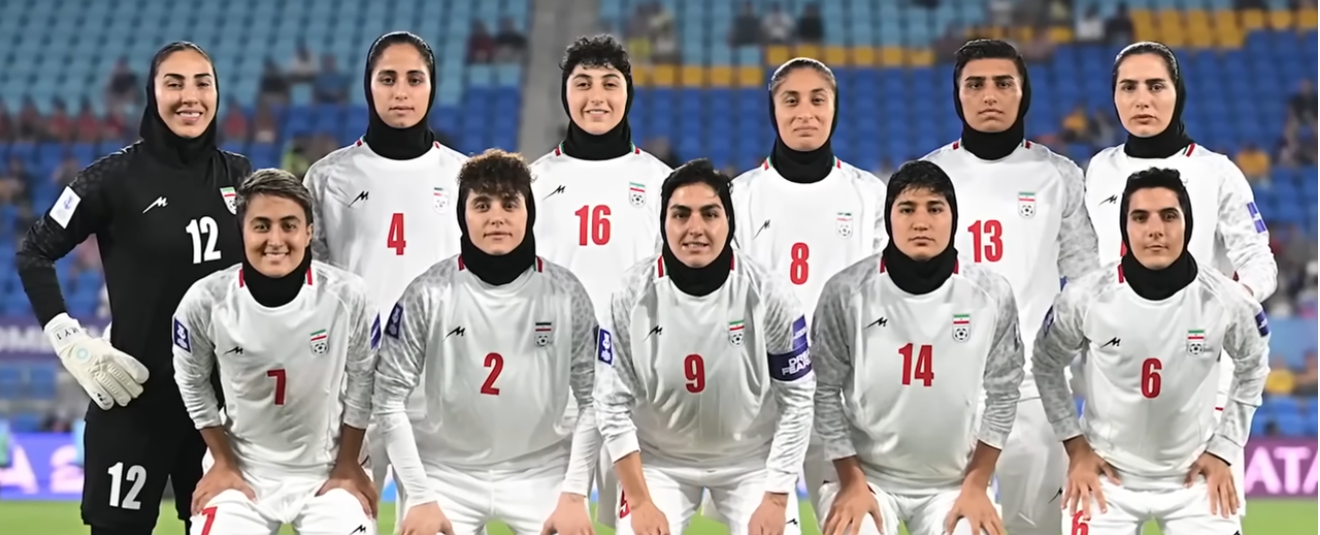
The enormous concrete bowl of Azadi Stadium is softly illuminated by floodlights on most evenings in Tehran. Outside vendors sell inexpensive scarves in red, white, and green as well as roasted sunflower seeds. It feels more like a celebration of national memory than a sporting event to watch the Iranian soccer team here, known simply as Team Melli. Echoes of decades of victory, frustration, and something more elusive can be heard in every chant.
By most accounts, Iran’s national team is among the most formidable football teams in Asia. Between 1968 and 1976, the nation won three AFC Asian Cup titles in a stunning run. Grainy but proud, that era continues to loom over Iranian football like a golden photograph. Recalling the grace of their passing and the quiet confidence that seemed to permeate the team, some older supporters speak of those teams with a sort of reverence.
| Category | Details |
|---|---|
| Official Name | Iran National Football Team (Team Melli) |
| Governing Body | Football Federation Islamic Republic of Iran (FFIRI) |
| Nicknames | Team Melli, Lions of Iran, Princes of Persia |
| First International Match | August 23, 1941 vs British India |
| AFC Asian Cup Titles | 1968, 1972, 1976 |
| World Cup Appearances | 1978, 1998, 2006, 2014, 2018, 2022, 2026 |
| Best Olympic Result | Quarter-finals, 1976 Summer Olympics |
| Home Stadium | Azadi Stadium, Tehran |
| Traditional Kit Colors | White home kit, red away kit |
| Reference Website | https://www.fifa.com |
However, history seldom proceeds in a linear fashion. Football was not an exception to how everyday life was altered by the Iranian Revolution of 1979 and the protracted Iran-Iraq War. Stadium attendance decreased. International contests became challenging. Iran’s national team spent a large portion of the 1980s in a state of sporting seclusion, quietly rebuilding while the nation struggled with more significant issues.
However, talent continued to emerge. Observers frequently note that Iranian football produces talented players who are almost unyielding in the face of an uncertain system. A new generation had emerged by the mid-1990s, and the national team was once again aiming for the international arena.
Iran’s 2-1 victory over the United States at the FIFA World Cup in France in 1998 is still remembered by many fans. There were layers of political tension in the game that went well beyond football. However, something unexpectedly kind happened on the field: players exchanging flowers prior to kickoff and awkwardly grinning for the cameras. It was an oddly optimistic scene.
The victory itself was very important to Iran. Mehdi Mahdavikia’s late goal and Hamid Estili’s looping header felt like sparks cutting through a protracted period of frustration. After that game, it’s possible to see entire neighborhoods celebrating in the streets of Tehran, with car horns resounding until midnight.
However, the World Cup has never quite produced the breakthrough that Iranian supporters had hoped for. The team has qualified multiple times, most recently for the tournament in 2026, but they have yet to reach the knockout stages. There’s always a feeling that the squad is near—near enough to taste it—but a little detail slips away. A late goal was given up. A lost chance.
One of those bittersweet moments occurred during the 2014 World Cup. Iran stubbornly defended against Argentina for almost ninety minutes. Lionel Messi then curled a shot into the corner. It was difficult to watch that goal play out without feeling both the quiet heartbreak of the Iranian players who had put in so much effort to hold the line and admiration for their brilliance.
Iran’s current teams frequently combine players from the diaspora—football players who were born and raised in Germany, Sweden, or the Netherlands but still have ties to Iran. This combination can occasionally result in an intriguing style that combines sudden bursts of technical creativity with disciplined defending.
In recent years, players like Mehdi Taremi and Sardar Azmoun have led the attack, scoring goals that momentarily improve the nation’s mood. There’s a sense in the stadium that anything could happen as Azmoun speeds toward goal with defenders pursuing him.
However, football and politics are rarely separate in Iran. The national team is frequently drawn into more extensive discussions, sometimes voluntarily and other times not. For instance, Iranian players made headlines during the 2022 World Cup when they declined to sing the national anthem prior to their first game. Although it was a small gesture, it caused a global stir.
There was a tension in the air that had nothing to do with formations or tactics when watching that moment on TV, with the players standing silently in line. Everyone was reminded that athletes occasionally have obligations that go far beyond the actual game.
Iran’s participation in international competitions is still uncertain. The team’s presence on the international scene is occasionally threatened by diplomatic disputes, travel restrictions, and political tensions. It’s still unclear how these factors will affect upcoming tournaments, such as the World Cup games that are set to take place in the United States. Nevertheless, the team continues.
Young athletes continue to train under dusty evening skies on training grounds outside of Tehran. Instructions are shouted by coaches. Balls hit the turf with a thud. Somewhere in those drills, perhaps, the next generation of Team Melli is forming.
It’s difficult not to be curious about what’s to come. Iran undoubtedly possesses the skill, the background, and the enthusiasm. That one World Cup run that turns a decent team into a legend is what it lacks, at least so far.
Perhaps that time is near. Or perhaps the tale will go unresolved for a bit longer. Certainty is uncommon in both football and history. However, hope usually endures.

Follow Live Media News on Google News
Get Live Media News headlines in your feed — and add Live Media News as a preferred source in Google Search.
Stay updated
Follow Live Media News in Google News for faster access to breaking coverage, reporting, and analysis.
- Search any trending topic on Google (for example: Greece news).
- On the results page, find the Top stories section.
- Tap Preferred sources and select Live Media News.