


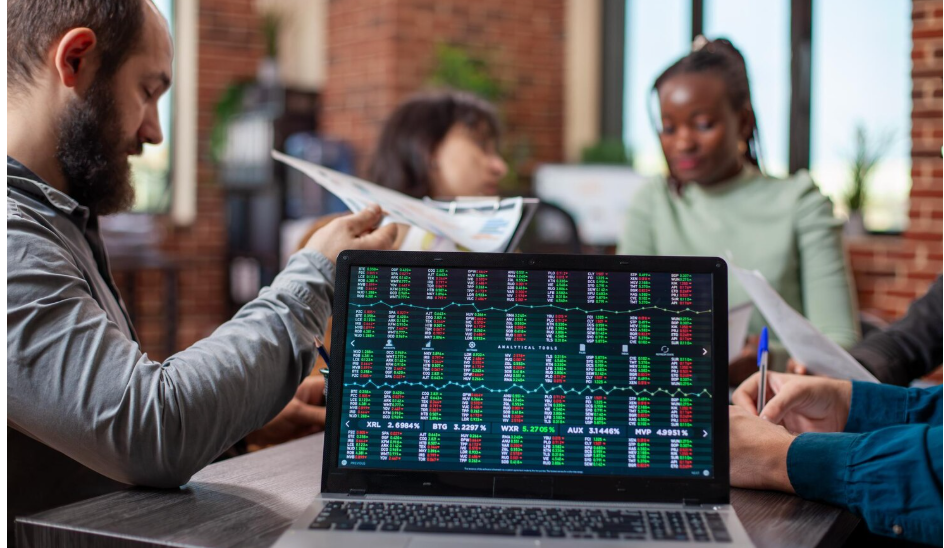
QQQ stock exudes a certain level of confidence that is more subdued and calm than the boisterous, anxious energy you occasionally feel around meme stocks or speculative plays. The name usually comes up in any serious discussion about long-term investing in the United States. Not always with great fanfare. Like a familiar face in a crowded room, it’s always there.
Nearly a year before the internet bubble reached its most dangerous peak, in March 1999, the fund started trading. The events that followed were not pleasant. As the dot-com frenzy faded into one of the worst market corrections in modern history, share prices fell more than 80%. Businesses that were once thought of as utilities proved to be nothing more than well-funded concepts. Following the Nasdaq-100, QQQ lost almost all of it. It was a harsh introduction to the real world for a fund that was only a year old.
| Information | Details |
|---|---|
| Full Fund Name | Invesco QQQ Trust, Series 1 |
| Ticker Symbol | QQQ |
| Fund Manager | Invesco |
| Inception Date | March 10, 1999 |
| Benchmark Index | Nasdaq-100 |
| Assets Under Management | ~$395 Billion |
| Expense Ratio | 0.18–0.20% per annum |
| 52-Week High | $637.01 |
| 52-Week Low | $402.39 |
| NAV | $562.66 |
| Average Volume | ~67 Million shares/day |
| 1-Year Performance | +21.39% |
| 5-Year Performance | +73.44% |
| Top Holdings | Apple, Microsoft, NVIDIA, Amazon |
| Official Reference | Invesco QQQ Official Page |
Looking back, the fund’s survival is remarkable. It didn’t just survive; in the end, it completely changed its own narrative. With approximately $395 billion in assets under management and a share price that reached $637 in just the last 12 months, QQQ stock has evolved into a gauge of investor sentiment toward the technology industry as a whole. Money comes in when there is a high level of confidence in technology. You start hearing the questions again when doubt appears, as it has in early 2026 (down roughly 6.4% year to date).
It is worthwhile to ponder those questions. The 100 biggest non-financial firms listed on the Nasdaq are included in the fund, which essentially indicates a strong bias toward biotech, consumer internet, and technology. At the top of the portfolio are Apple, Microsoft, NVIDIA, and Amazon, and just those four names have a lot of clout.
It’s possible that this concentration is precisely what draws believers to QQQ: instead of spreading thin across hundreds of mediocre businesses, you’re using a single, inexpensive, liquid instrument to own the most significant companies in the world. It’s also possible that risk managers are kept up at night by their inability to focus.
In August 2023, Scion Asset Management was reportedly positioned against QQQ by Michael Burry, the investor who gained notoriety in 2008 for his astute wager against the housing market.
That was a memorable occasion. A wager against QQQ is really a wager against the sustained domination of the American technology industry, and Burry doesn’t make lighthearted gestures. The market didn’t appear to be very affected, at least not in the months that followed. In July 2023 alone, the fund received $5.3 billion in inflows, indicating that there were many more believers contributing money than skeptics.
For some investors, QQQ seems to have become almost ideological. Purchasing it is a clear indication that the businesses that are changing how people work, communicate, and consume will continue to expand over time—not in an illogical way. Even after taking into consideration the dips along the way, the five-year return of 73.44% is difficult to dispute. Nevertheless, the performance so far this year serves as a silent reminder that nothing stays the same forever.
It’s important to be aware of the fund’s ticker history. In 2004, it made an administrative change from QQQ to QQQQ. In 2011, it quietly changed back to QQQ. While the original QQQ has traditionally been the preferred tool for institutional traders moving big blocks, Invesco also introduced QQQM, a sibling fund with a lower share price targeted at retail investors. It is one of the most actively traded ETFs worldwide, with an average daily volume of about 67 million shares, so getting in or out is rarely an issue. Such liquidity is important, particularly in volatile markets.
The annual expense ratio is between 0.18 and 0.20%, which is practically nothing for what you’re getting. One of those unglamorous facts that often matters far more than it first appears is keeping costs low over decades of compounding. It’s simple to undervalue a fund that silently costs you money in fees until you look at the figures over a 20-year period. One of QQQ’s most genuinely helpful but least discussed features is its cost structure.
It’s difficult to ignore the fact that QQQ stock has experienced the kind of volatility that would have permanently undermined investor confidence in practically any other asset. a drawdown of 80%. the financial crisis of 2008. Early in 2020, there was a pandemic crash, and in June of the same year, there was a record high.
Every time, the narrative managed to go on. It is genuinely unclear whether it will continue through the current turbulence, which includes geopolitical unpredictability, growing concerns about tech valuations, and a cautious Federal Reserve. However, the money is still coming in. And that typically has some significance in markets.

Follow Live Media News on Google News
Get Live Media News headlines in your feed — and add Live Media News as a preferred source in Google Search.
Stay updated
Follow Live Media News in Google News for faster access to breaking coverage, reporting, and analysis.
- Search any trending topic on Google (for example: Greece news).
- On the results page, find the Top stories section.
- Tap Preferred sources and select Live Media News.