


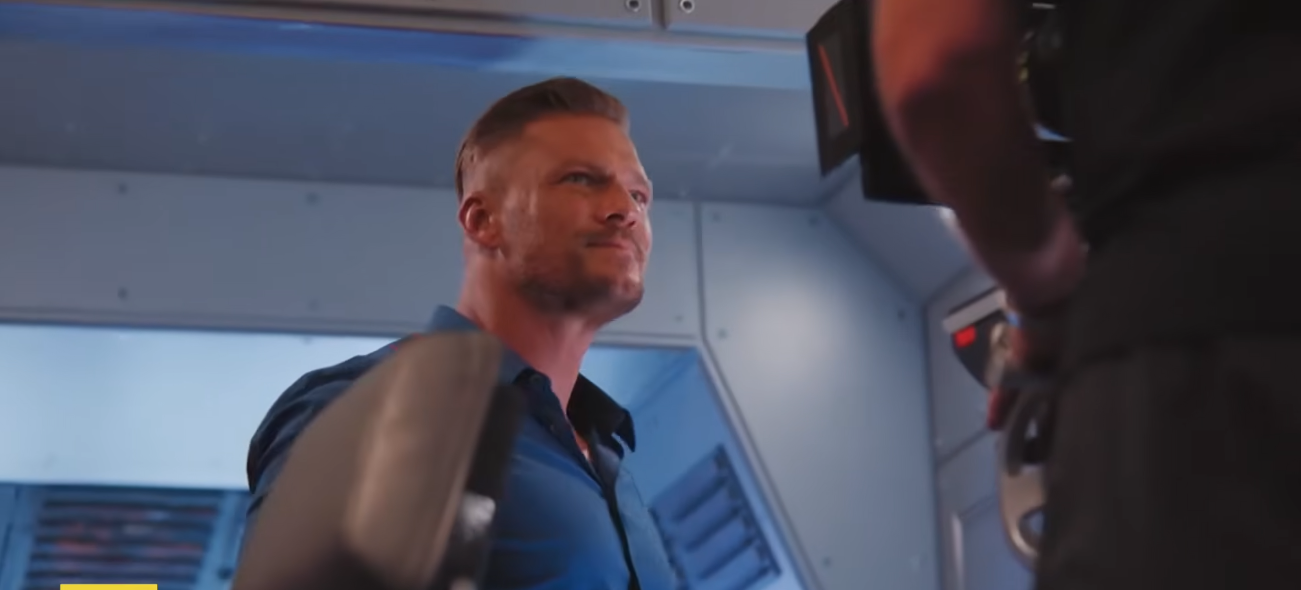
Violence taking place in areas meant to be peaceful—tree-lined streets, driveways with well-parked cars, children somewhere out of frame—is unsettling. That serenity was momentarily disturbed in Brentwood, Tennessee, when Alan Ritchson, who is well-known for portraying restrained aggression on screen, got into a very real altercation with Ronnie Taylor, his neighbor.
It wasn’t a spectacle at first. Seldom does it. A motorcycle went by in the neighborhood; it was green, conspicuous, and loud enough to draw attention. Taylor appears to have made a choice at that very moment as he stands outside with his own bike and watches it pass once, then again. Go ahead. Speak up. It’s possible that he was thinking about safety and trying to slow things down before something worse occurred.
| Category | Details |
|---|---|
| Primary Figure | Alan Ritchson |
| Second Individual | Ronnie Taylor |
| Location | Brentwood, Tennessee, USA |
| Incident Date | March 2026 |
| Core Issue | Alleged reckless motorcycle riding leading to confrontation |
| Legal Outcome | No charges filed; self-defense determination |
| Authority | Brentwood Police Department |
| Reference | https://www.tmz.com |
However, once bodies get closer, voices get louder, and space becomes more constrained, intention tends to evaporate.
The kind of escalation that feels both abrupt and predictable is captured in video footage, which can be intimate at times and grainy at others. Ritchson is blocked when Taylor enters the street. A pause is followed by movement. A push. Then one more. It’s still unclear if either man anticipated a physical altercation even seconds before the first blow. However, they did. Fast.
There is a physicality in the video that seems more like instinct taking over than choreography. Ritchson reacts by setting down his bike and pushing back. Eventually, the dynamic shifts from confrontation to combat, from disagreement to survival. Afterwards, authorities noted that Taylor made the initial contact and characterized Ritchson’s actions as self-defense. Legally, that distinction is important. It’s less tidy emotionally.
For his part, Taylor maintains that this wasn’t supposed to turn out the way it did. Speaking later, he characterized himself as someone who was trying to “slow down” and expressed concern. There’s a feeling that he honestly didn’t anticipate the interaction getting out of control. Even so, he acknowledges pushing Ritchson twice. That particular detail lingers. Little but decisive. The aftermath comes next.
Bodycam footage, witness statements, and tangible proof of a fight that left one man on the ground and another leaving with a valid reason were all examined by the police. No fees. The case is closed. On paper, clean. However, resolution in human terms does not always equate to closure in legal terms.
It’s difficult to ignore how rapidly the narrative spread outside of Brentwood. videos that are making the rounds online. The edges are sharpened by headlines. A local conflict growing into something more significant, almost symbolic. Yes, there was a celebrity involved, but there was also something more common: neighbors fighting over boundaries, space, and noise. The kind of tension that is present in many places but seldom comes to the surface in such a dramatic way.
The issue of perception is another. Ritchson, who is renowned for his portrayal of a disciplined, almost calculating kind of strength in “Reacher,” appears out of nowhere in an uncontrollably raw moment. It validates something about him for some. It goes against the persona for others. Perhaps that’s the point, though. Under duress, people are rarely reliable.
Taylor’s story, meanwhile, offers an additional dimension that is shaped by hurt, annoyance, and the sense of being ignored. He says he was unaware of Ritchson‘s notoriety. Strangely, the story feels more grounded because of that detail. At first, this had nothing to do with celebrity. It was about a man on the street, another man riding a bike, and an argument that got out of hand.
Beneath all of this is a larger cultural thread. Communities are evolving. People’s sensitivity to noise, perceived dangers, and other people’s actions is growing. It’s possible that what transpired in Brentwood isn’t as unusual as it seems; it’s just more obvious because of the people involved. It feels unresolved in some way, though.
The police have moved on. The issue has been officially resolved. However, there is a persistent impression that both men left with their own version of events intact after watching the video and reading the statements. And perhaps that’s where the tension still exists—not in the blows delivered, but in the tales recounted afterwards.
Because it wasn’t just a fight in the end. In the middle of a peaceful street, two interpretations of reality collided, leaving behind something more elusive than guilt or innocence. Just discomfort.

Follow Live Media News on Google News
Get Live Media News headlines in your feed — and add Live Media News as a preferred source in Google Search.
Stay updated
Follow Live Media News in Google News for faster access to breaking coverage, reporting, and analysis.
- Search any trending topic on Google (for example: Greece news).
- On the results page, find the Top stories section.
- Tap Preferred sources and select Live Media News.