


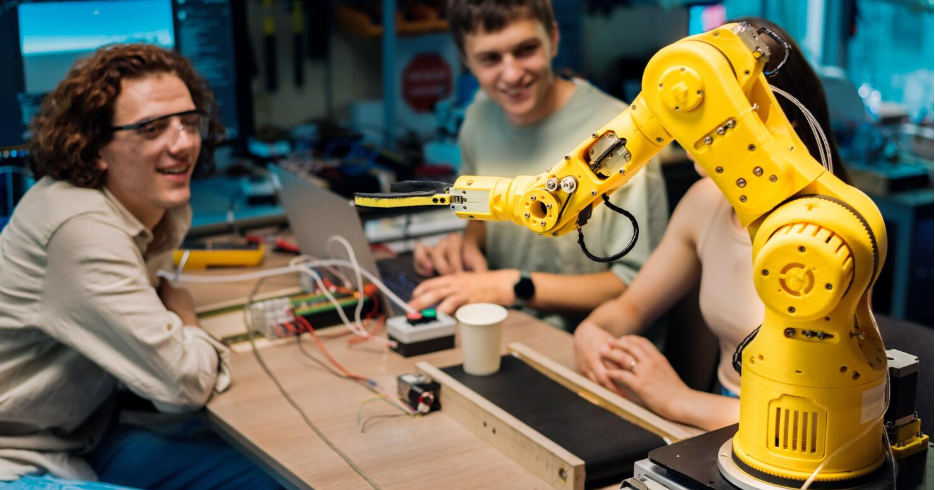
Robotic arms silently and confidently move microliters of liquid between plates in a glass-walled lab outside Cambridge. No lab coat. No breaks for coffee. Only the gentle click of plate readers measuring optical density at 595 nanometers broke the constant hum. It’s difficult to ignore how commonplace this feels right now.
Although repetitive tasks like pipetting, plate washing, and compound screening have long been performed by robots, the shift goes beyond efficiency. Early Robot Scientists, such as “Adam” and “Eve,” have developed theories, planned experiments, and determined the roles of yeast genes. Automation as an assistant is not what that is. That is the beginning of authorship through automation. Furthermore, it poses the awkward question of who owns a discovery made by a robot.
| Category | Details |
|---|---|
| Organization | Pistoia Alliance |
| Founded | 2007 |
| Headquarters | London, United Kingdom |
| Focus | Pre-competitive collaboration in life sciences R&D |
| Key Interest | Robotics, AI, standards, data interoperability |
| Notable Concept | Robot Scientist (e.g., Adam and Eve systems) |
| Website | https://www.pistoiaalliance.org |
Ownership was easy for years. An idea was developed, experiments were conducted, and a patent was filed by a human scientist. These days, closed-loop learning systems use databases to generate hypotheses, test them on their own, improve models, and then repeat the process. It seems like something fundamental is changing as you watch these systems iterate over night, evaluating growth curves, improving predictions, and changing compound selections. The machine is doing more than just following commands. It is influencing the course of research.
It appears that investors think this change is unavoidable. Cloud labs, AI-powered biotech startups, and automated drug discovery platforms have all seen a surge in venture capital. Experiments can be ordered online and carried out in fully automated “lab-in-a-box” facilities without a single human hand ever touching a pipette. The economic rationale is obvious: robots scale remarkably consistently, work around the clock, and minimize contamination. However, the scale of intellectual property law has not been as smooth.
The notion that an AI system can be identified as an inventor has been rejected by recent court rulings in the US, UK, and Europe. The logic is simple: natural persons are recognized by patent law. Even autonomous machines are not eligible. As systems grow more complex and produce new compounds or gene-editing techniques that no human has specifically thought of, it is still unclear if that principle will hold true.
This uncertainty permeates the quiet discussions in pharmaceutical R&D departments. Before a robot suggests a novel metabolic pathway, a computational biologist may adjust model parameters. The training dataset that directs compound selection may be modified by a machine learning engineer. The last molecule was “invented” by whom? The scientist in charge? The group? The business? Or the hypothesis-generating system?
When it comes to biological robotics, the uncertainty grows. With remarkable specificity, viral vectors created via precise genome editing can transport DNA payloads. The boundaries between software and biology are blurred by DNA origami nanomachines, which are constructed from the bottom up and self-assemble into programmable structures. Authorship becomes a distributed phenomenon when the drug itself is inextricably linked to the delivery mechanism’s design. There isn’t just one “aha” moment. Only iterative improvement, with some code guidance.
In the past, technology advanced faster than regulation before settling into an uncomfortable alignment. Agriculture was mechanized by the industrial revolution long before labor laws changed to reflect this. Prior to the development of privacy frameworks, cloud computing gained popularity. Lab automation might be exhibiting the same trend, with innovation leading the way and legal doctrine trailing behind.
But ownership is more than just a formality. It establishes incentives. The commercial value could be huge if a company uses a Robot Scientist who, like Adam, discovers twelve new gene-enzyme relationships. Patents influence competitive advantage, partnerships, and funding. There is a subtle tension here: does the human role appear more ceremonial if the machine’s contribution takes center stage?
Some contend that robots are just tools, similar to sequencers or microscopes. It’s a comfortable analogy. However, it might also be lacking. No hypothesis is formed or the next experiment is chosen by a microscope. Systems with closed loops do. They use deductive, inductive, and occasionally abductive reasoning to produce testable hypotheses based on prior knowledge. It feels different than watching a centrifuge spin to watch that process play out on a monitoring dashboard, where experiments are scheduled automatically and hypotheses are recorded in formal ontologies.
The larger cultural undercurrent is another. Patients may be comfortable with robotic surgery because it eliminates human error, but they may be uncomfortable with gene-editing nanomachines that are designed to act before illness appears. In the past, society has opposed technologies that appear to replace human agency. Acceptance frequently comes after, though not always without conflict.
Maybe the more important question is how ownership changes rather than who owns the robots’ discoveries. Currently, companies give inventorship to the system designers, human operators, or the organization that funds the research. That complies with current law. Another question is whether it satisfies philosophical intuition.
There’s a chance that new frameworks will appear, such as classifying “AI-assisted invention” or redefining inventorship as a cooperative human-machine act. This debate seems to be just getting started. The Pistoia Alliance and other consortia have placed a strong emphasis on cooperation and common standards, implying that group advancement might be more significant than individual assertions.
However, abstraction wanes when billions of dollars are riding on a molecule that was found at three in the morning by a robot arm that dispensed 75 microliters into a microplate. Ownership takes on a tangible form. It can be found in courtroom arguments, patent filings, and contracts.
One feels both awed and uneasy as they stand in a contemporary automated laboratory and watch robotic arms move past barcode scanners and freezer units that are running at -80°C. The speed of science is increasing. The machines are gaining knowledge. The findings are authentic.

Follow Live Media News on Google News
Get Live Media News headlines in your feed — and add Live Media News as a preferred source in Google Search.
Stay updated
Follow Live Media News in Google News for faster access to breaking coverage, reporting, and analysis.
- Search any trending topic on Google (for example: Greece news).
- On the results page, find the Top stories section.
- Tap Preferred sources and select Live Media News.