


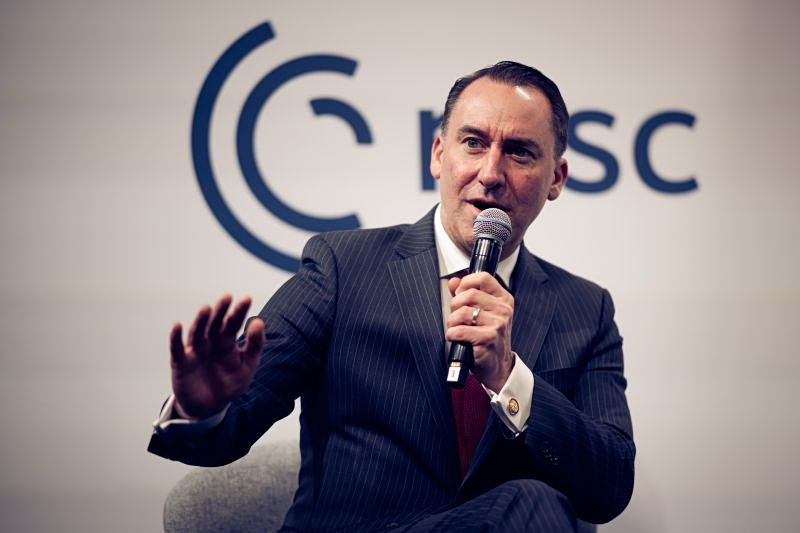
A senior Trump administration energy official has praised recent energy cooperation agreements between the United States and Greece, highlighting their strategic importance for European energy security. Jarrod Agen, executive director of the National Energy Dominance Council, delivered the remarks Saturday at the Munich Security Conference, emphasizing Greece’s role in US LNG distribution to Europe.
During his address at the high-profile international security gathering, Agen specifically recognized Greek Environment and Energy Minister Stavros Papastavrou, who was present in the audience. The executive director singled out the minister for what he described as an adulatory acknowledgment of Greece’s energy partnership efforts.
Vertical Corridor Initiative Gains US Support
Central to Agen’s remarks was the so-called vertical corridor, an ambitious infrastructure concept designed to transport American liquefied natural gas through Greece to southeastern Europe and Ukraine. According to Agen, this route would utilize LNG terminals in Greece as entry points for US gas shipments destined for energy-hungry markets further north. The initiative represents a significant component of Washington’s strategy to reduce European dependence on alternative energy suppliers.
The Trump administration official characterized energy cooperation as more than a commercial endeavor. He described energy as a tool to achieve peace in Ukraine, linking natural gas supply routes to broader geopolitical objectives in the region. This framing suggests the administration views LNG exports as serving both economic and strategic foreign policy goals.
Upcoming Ministerial Meetings Announced
Agen announced that a focused ministerial meeting on the vertical corridor will convene in Washington D.C. on February 24. According to the executive director, all relevant energy ministers will travel to the United States to discuss additional agreements aimed at making the vertical corridor operational. The gathering signals accelerating diplomatic efforts to formalize the infrastructure arrangements necessary for the project.
Additionally, Agen revealed that subsequent discussions would take place in Houston, Texas, during CERAWeek, scheduled for March 23-27. The major energy industry conference regularly draws ministers, executives, and policy officials from around the world. Holding vertical corridor talks at this venue would provide opportunities for both government-to-government coordination and private sector engagement.
Strategic Implications for Greece and Regional Energy Security
The energy cooperation agreements position Greece as a critical gateway for US LNG entering European markets. Greece’s existing and planned terminal infrastructure makes it geographically suited to receive shipments and redistribute them northward through pipeline networks. This role could enhance Greece’s strategic importance within NATO and EU energy policy frameworks.
Meanwhile, the vertical corridor concept addresses ongoing European concerns about energy supply reliability. With southeastern Europe and Ukraine seeking to diversify their natural gas sources, American LNG routed through Greece offers an alternative to existing supply arrangements. However, authorities have not confirmed specific capacity targets or timelines for full corridor implementation.
In contrast to previous energy discussions that focused primarily on commercial terms, Agen’s framing explicitly connected LNG infrastructure to peace and security objectives. This approach reflects the Trump administration’s emphasis on what it terms energy dominance as a foreign policy instrument.
The February ministerial meeting in Washington is expected to produce concrete progress on technical and regulatory frameworks needed to operationalize the vertical corridor, though specific deliverables have not been announced. Further details may emerge as the conference date approaches and participating countries finalize their negotiating positions.

Follow Live Media News on Google News
Get Live Media News headlines in your feed — and add Live Media News as a preferred source in Google Search.
Stay updated
Follow Live Media News in Google News for faster access to breaking coverage, reporting, and analysis.
- Search any trending topic on Google (for example: Greece news).
- On the results page, find the Top stories section.
- Tap Preferred sources and select Live Media News.