


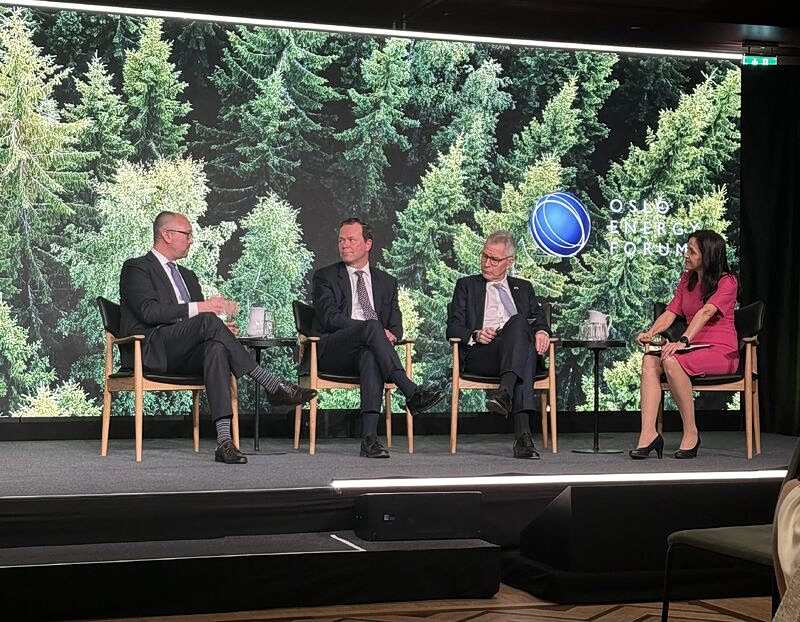
The Oslo Energy Forum 2026 concluded at the historic Holmenkollen venue, bringing together international leaders to address energy security challenges and opportunities amid global uncertainty. Former U.S. Ambassador to Greece Geoffrey R. Pyatt, now Senior Managing Director of Energy and Critical Minerals at McLarty Associates, delivered key interventions on critical minerals supply chains, transatlantic cooperation, and the geopolitical dimensions of the current energy transition.
The forum convened under the theme “Energy and Security in Unpredictable Times – A New Global Order?” and featured participation from Norwegian Prime Minister Jonas Gahr Støre, Foreign Minister Espen Barth Eide, and ambassadors from across Europe, Asia, and Latin America. Pyatt participated in two major panels examining critical minerals resilience and challenges facing the energy industry alongside experts from the Atlantic Council, Norsk Hydro, and Columbia University.
U.S.-Norway Partnership Strengthens Energy Security
Reflecting on the longstanding bilateral relationship, Pyatt highlighted how American LNG and Norwegian pipeline gas came to Europe’s rescue when Russia curtailed deliveries four years ago as part of its hybrid strategy preceding the invasion of Ukraine. According to Pyatt, he co-chaired the U.S.-Norway Energy and Climate Dialogue with Petroleum and Energy Minister Terje Aasland, deepening cooperation on energy security and critical mineral supply chains.
The discussions emphasized that moving from ambition to implementation requires alignment of energy policy, industrial strategy, and recycling initiatives. Additionally, experts noted that aluminium resilience operates on two timelines: short-term supply security through increased regional recycling, and long-term strategic autonomy through competitive and reliable energy supply.
Critical Minerals Take Center Stage
Pyatt’s panel on “The Role of Critical Minerals and Materials” featured Landon Derentz from the Atlantic Council and Eivind Kallevik from Norsk Hydro, focusing on vulnerabilities in critical minerals supply chains. The forum highlighted the strategic importance of materials such as aluminium and the role of regions like the Arctic and Greenland for both European and American interests.
Drawing on his experience as Assistant Secretary in the U.S. Bureau of Energy Resources, Pyatt analyzed how critical minerals security intersects with geopolitical stability. His presence underscored close U.S.-Norway cooperation reinforced by the 2023 joint declaration on secure and sustainable supply chains and clean energy technologies.
Ukraine Support Remains Priority
Addressing geopolitical challenges, Pyatt emphasized the importance of continuing support for Ukraine as Russia targets energy infrastructure. According to Pyatt, Foreign Minister Espen Barth Eide made important remarks on Kremlin attacks, and he stressed the need to sustain energy sector support while pushing for an immediate ceasefire urged by Ukraine, the United States, Norway, and the European Union.
Pyatt praised Norway’s Ministry of Foreign Affairs for strong leadership in the G7+ energy sector support group and for consistently highlighting the energy dimension of NATO’s response to Russia’s full-scale invasion. Meanwhile, discussions throughout the forum showcased the energy transition as both an opportunity and a challenge for Europe and the global community.
Strategic Autonomy and Industrial Resilience
The second panel, “Challenges for the Energy Industry,” included Jason Bordoff from Columbia University’s Center on Global Energy Policy and Vijay Swarup, former Senior Director for Climate Strategy and Technology. Participants examined how energy policy connects to industrial resilience and the necessity of strategic autonomy in critical materials.
In contrast to purely economic frameworks, Pyatt stressed that energy transition and critical minerals security are central to geopolitical stability. However, the discussions acknowledged that achieving this balance requires coordinated international cooperation and sustained policy commitment across multiple sectors.
High-Level Participation Underscores Forum Importance
The Oslo Energy Forum 2026 reaffirmed its status as a premier international event with participation from Norwegian Chief of Defence Eirik Kristoffersen, Norwegian Oil Fund head Nicolai Tangen, and former Norwegian Ambassador to Greece Frode Øyvind Andersen. Their presence underscored the forum’s strategic significance for Europe, NATO, and the international energy community.
The forum’s outcomes and continued dialogue are expected to influence ongoing U.S.-Norway cooperation and broader transatlantic energy security initiatives, though specific policy announcements and implementation timelines remain to be determined by participating governments.

Follow Live Media News on Google News
Get Live Media News headlines in your feed — and add Live Media News as a preferred source in Google Search.
Stay updated
Follow Live Media News in Google News for faster access to breaking coverage, reporting, and analysis.
- Search any trending topic on Google (for example: Greece news).
- On the results page, find the Top stories section.
- Tap Preferred sources and select Live Media News.