


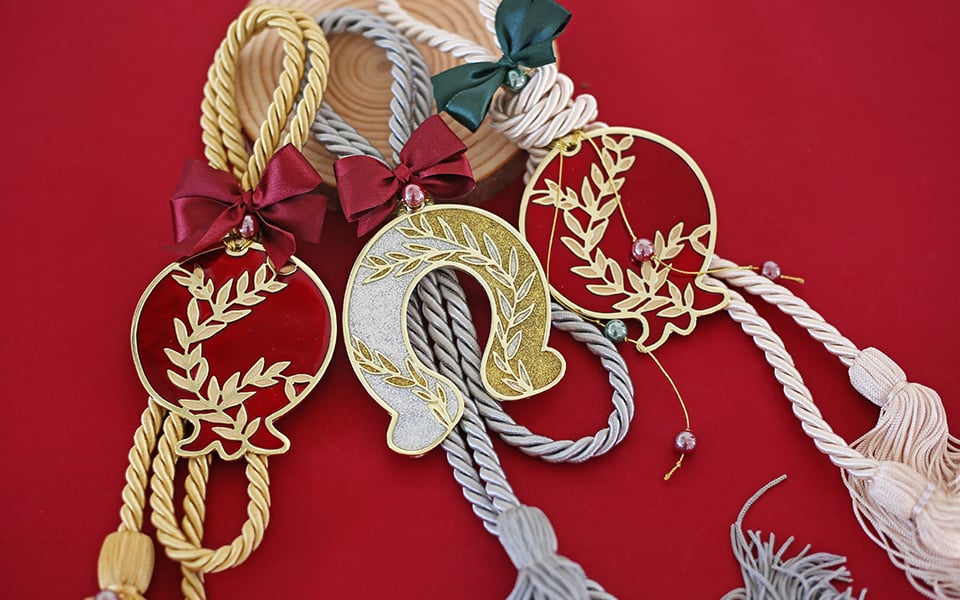
As the year draws to a close in Greece, shop windows fill with brightly colored charms, ornamental pomegranates, and blue glass evil eyes. These Greek New Year charms, known as gouria, represent a centuries-old tradition of exchanging symbolic objects intended to bring luck, health, and prosperity for the year ahead. The gouri has become an essential part of Greek New Year celebrations, blending ancient beliefs with modern design.
At first glance, a gouri may appear as a simple pendant, bracelet, keyring, or small ornament stamped with the coming year’s number. However, this humble object carries a much deeper story rooted in Mediterranean traditions of using symbolic items to influence fate, particularly during transitional moments like the threshold between years.
Ancient Origins of Greek New Year Charms
The word gouri means both “good luck” and “good-luck charm,” with linguistic roots that reveal rich cultural layering. According to most scholars, the modern Greek term likely derives from the Turkish word “uğur,” meaning “good omen,” itself possibly linked to the Latin “augurium.” This overlap demonstrates how ideas about luck and protection have traveled across the eastern Mediterranean for millennia.
Ancient Greeks lived in a world shaped by uncertainty, where disease, travel, and harvests carried enormous risk. Long before gouria became New Year gifts, Greeks carried amulets, engraved gemstones, coins, and small talismans believed to hold protective powers. These objects were worn on the body or placed in homes, serving as portable expressions of hope in an unpredictable world.
Additionally, these practices absorbed new layers of meaning over time. As Christianity spread, pagan amulets adapted rather than disappeared, giving way to crosses and saints’ medals while folk beliefs continued alongside official doctrine. The custom evolved, but the fundamental desire for symbolic protection remained constant.
The Evil Eye and Traditional Symbols
In Greece and the wider Mediterranean, the evil eye, or “mati,” stands out as one of the most enduring symbols. The blue eye talisman is believed to protect against envy and malevolent gazes, making it especially common on newborn babies’ cots and prams. Archaeological evidence suggests that fear of the evil eye dates back to the Late Bronze Age around 1500 BC, with even earlier examples found in Mesopotamia at Tell Brak in modern-day Syria, dated to approximately 3300 BC.
By the 19th century, these older traditions coalesced into something more specific. The gouri became firmly associated with the turning of the year, transforming from simple protection into a marker of time itself. The practice of exchanging charms at New Year evolved to symbolize renewal and fresh beginnings.
Despite modern skepticism, belief in lucky objects still runs deep in Greece. From icons worn close to the body to charms hung in homes, cars, and workplaces, many Greeks continue to surround themselves with symbolic safeguards against misfortune. During the festive season, gouria appear everywhere, exchanged between family members, friends, and colleagues with a simple message of goodwill.
Contemporary Design and Craftsmanship
Today’s gouria have transformed from folk objects into design statements. Contemporary designers and artisans across Greece reinterpret traditional symbols using gold, silver, ribbons, beads, textiles, ceramics, and precious stones. The year itself is almost always incorporated into the design, fixing the object to a particular moment while its symbolism reaches much further back.
Meanwhile, many makers speak of “meraki” – the care and personal investment poured into each piece – as equally important as the finished result. Museums and cultural institutions increasingly treat gouria as compact cultural artifacts, with museum gift shops offering handmade charms inspired by ancient jewelry, coins, and architectural details. These make popular souvenirs that connect past with present.
Symbolic Motifs and Their Meanings
The pomegranate stands as perhaps the most potent symbol among Greek lucky charms. Associated since antiquity with fertility, abundance, and renewal, it remains deeply embedded in Greek New Year custom. In many households, a pomegranate is smashed on the threshold at the start of the year, its seeds scattering as a hopeful sign of prosperity.
In contrast, the coin represents luck’s playful side. Most famously hidden inside the vasilopita New Year’s cake, whoever discovers it is said to enjoy good luck for the year ahead. The sailing boat also features prominently, reflecting Greece’s maritime heritage and symbolizing safe journeys, opportunity, and fresh horizons – a fitting image for the year ahead.
As another New Year approaches, the tradition of exchanging gouria continues to thrive across Greece, offering a distinctly Greek way of marking time with symbolism, care, and modest faith in good fortune. The custom shows no signs of fading, remaining an integral part of how Greeks welcome each new year with hope and optimism.

Follow Live Media News on Google News
Get Live Media News headlines in your feed — and add Live Media News as a preferred source in Google Search.
Stay updated
Follow Live Media News in Google News for faster access to breaking coverage, reporting, and analysis.
- Search any trending topic on Google (for example: Greece news).
- On the results page, find the Top stories section.
- Tap Preferred sources and select Live Media News.