


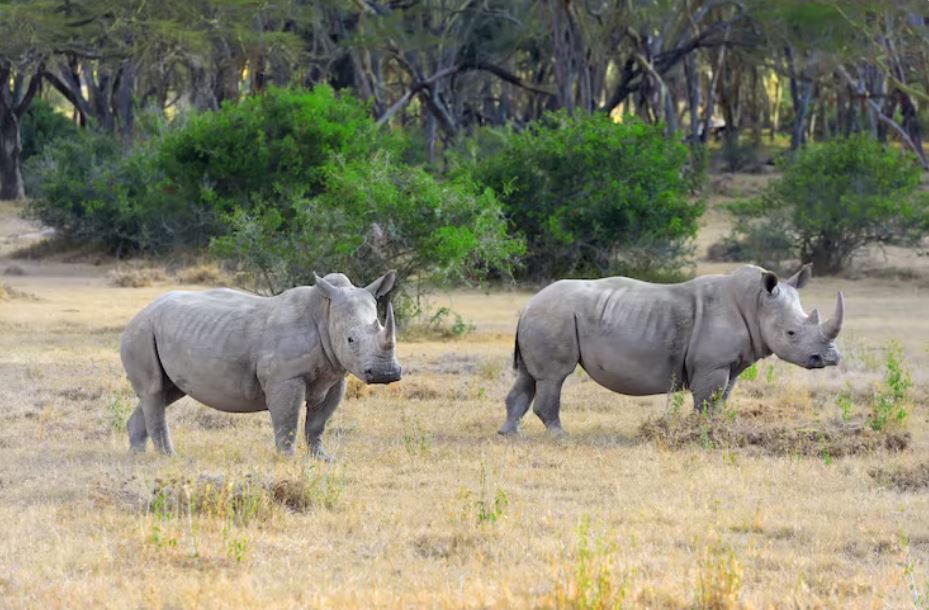
Two rhinoceroses graze in a large fenced enclosure on a conservancy in central Kenya, close to the town of Nanyuki and the equator that crosses it. The animals are guarded by armed rangers who work in shifts around the clock. The perimeter is scanned by motion sensors. Nearby, a specialized K-9 unit is on patrol. The region is monitored from above by aerial surveillance. These two animals’ security systems wouldn’t be out of place guarding a high-security facility or a diplomatic compound.
In a way, it is: Najin and Fatu, a mother and daughter who together make up the entire surviving population of their subspecies, are the last two northern white rhinoceroses on the planet. There isn’t a backup population anywhere else. No reserve herd in another nation. There isn’t a wild group in a far-off part of Central Africa. Just these two creatures, and the tremendous scientific work being done to make sure their lineage doesn’t end with them.
Northern White Rhino — Species & Conservation Profile
| Surviving Population | 2 individuals — both female, both at Ol Pejeta Conservancy, Kenya |
| The Last Two | Najin (mother, elderly) and Fatu (daughter, born 2000) — neither can carry a pregnancy |
| Last Male (Sudan) | Humanely euthanized March 2018, aged 45 — wounds and degeneration; sperm preserved |
| Historical Population (1960) | ~2,360 individuals across Central Africa |
| Declared Extinct in Wild | 2008 — last wild sightings in DRC’s Garamba National Park circa 2006 |
| Conservation Project | BioRescue — international consortium led by Leibniz IZW Berlin, Dvůr Králové Zoo, Avantea Italy, Ol Pejeta |
| Method | IVF — Fatu’s eggs + frozen sperm from Suni (died 2014) → lab embryo → southern white surrogate |
| 2023 Milestone | First-ever successful rhino embryo transfer into a surrogate — proof of concept achieved; surrogate died from unrelated infection |
| Embryos in Storage | Multiple viable embryos cryofrozen in Cremona, Italy (Avantea laboratory) |
| Security at Ol Pejeta | 24/7 armed guards, electric fences, K-9 unit, motion sensors, aerial surveillance |
For years, James Mwenda has been a keeper at Ol Pejeta Conservancy, where he has witnessed the numbers drop from seven to two. He refers to it as “an emotional freefall.” More impactful than any dramatic framing could be is the way he says it, matter-of-factly, as someone who has come to terms with witnessing something terrible. He takes care of Najin and Fatu every day, being intimately familiar with their unique routines and emotions. After spending years at the Dvůr Kělové Zoo in the Czech Republic, where she was born, Najin, the elder, is at ease and somewhat accustomed to people. Fatu is more aggressive. Neither is capable of carrying a pregnancy. The entire conservation strategy has had to be constructed around this biological fact.
One of the most agonizing recent developments in conservation is the decline of the northern white rhino population. In what is now Sudan, the Democratic Republic of the Congo, Uganda, and the Central African Republic, there were about 2,360 northern white rhinos in Central Africa in 1960. Decade by decade, that population was reduced by institutional failures, systematic poaching for horn, and civil wars. Only about fifteen remained in the Garamba National Park of the Democratic Republic of the Congo by 1984.
By the mid-1990s, numbers had somewhat recovered under stringent protection, reaching about 30. However, poaching pressure returned, and the DRC government turned down an international offer to relocate some animals to safety while the numbers were still high enough to be significant. Only four animals in Garamba were confirmed by surveys by 2006. Since 2007, there have been no reports of live rhinos or any indications of them in the wild, such as footprints or dung. In 2008, the subspecies was deemed to be extinct in the wild. The DRC’s decision to forbid translocation when the number was thirty was the point at which a different result was still possible, according to Save the Rhino’s straightforward analysis of what went wrong. No one took it.
The ambition of the scientific response to what came next is astounding. Four of the remaining northern white rhinos, Najin, Fatu, and two males named Suni and Sudan, were moved from the Dvěr Kělové Zoo to Ol Pejeta in 2009 with the intention of encouraging breeding in the natural African habitat. It didn’t. Due to various medical conditions, both women were unable to conceive.
In 2014, Suni passed away. Sudan, the last male on the planet, was humanely put to death in March 2018 at the age of 45. His muscles and bones had deteriorated beyond repair, and his wounds were incapable of healing. His sperm was meticulously gathered and preserved before he passed away. Suni’s was also gathered when she was younger and thought to be healthier. The northern white rhino male lineage’s only remaining genetic inheritance is that frozen biological material.
The BioRescue consortium’s reproductive science work has been led by Dr. Thomas Hildebrandt of Berlin’s Leibniz Institute for Zoo and Wildlife Research, and the difficulties he has overcome are truly unique. Because a rhino’s skin is about 5 centimeters thick and does not heal once cut, it is necessary to navigate approximately 1.5 meters inside the animal, past intestinal loops, in order to reach the female rhino’s ovaries, where eggs are stored. This method does not apply to horses or large cats.
Hildebrandt created a unique ultrasound-guided probe method that can gather eggs without putting Fatu’s life in jeopardy. Following a quick charter flight from Nairobi to Frankfurt, the eggs are matured, fertilized using Suni’s preserved sperm, and evaluated for viability at the Avantea laboratory in Cremona, Italy. Those that make it through that procedure are cryofrozen. Fifteen years ago, when Hildebrandt himself described the situation as hopeless in 2012, it would have seemed impossible that there are now several viable northern white rhino embryos in storage in Italy.
A successful embryo transfer into a southern white rhino surrogate was accomplished by BioRescue in 2023, a first for rhino conservation. Before passing away from a bacterial infection unrelated to the procedure, the surrogate—a closely related subspecies with a population of about 20,000, far enough to support a surrogate program—carried the embryo. Despite the tragic death, the scientific fact that the technique is effective persisted. It is feasible to transfer embryos into rhino surrogates. Prior to that point, it had never been proven, and now it has.
As this endeavor has developed over the years, there is a sense that what BioRescue is trying to accomplish is at the limit of what science is currently capable of, and that there is an uncomfortably narrow margin between success and failure at every stage. Finding healthy southern white females, preparing them medically, scheduling the transfer appropriately, and managing a 16-month pregnancy in an animal being asked to carry the offspring of another subspecies are all necessary for the surrogate program.
Eventually, it must work several times to create a population that can support itself. It takes a long time to develop a viable breeding group from two frozen embryos. However, the embryos are real. The method has been verified. The alternative, doing nothing, has a result that can be predicted without the need for scientific modeling. Fatu and Najin are getting older. It’s clear that BioRescue is racing against a closing window. The question of whether it is worthwhile to try is no longer relevant. Of course it is. Whether it can be completed on time is the question.

Follow Live Media News on Google News
Get Live Media News headlines in your feed — and add Live Media News as a preferred source in Google Search.
Stay updated
Follow Live Media News in Google News for faster access to breaking coverage, reporting, and analysis.
- Search any trending topic on Google (for example: Greece news).
- On the results page, find the Top stories section.
- Tap Preferred sources and select Live Media News.