


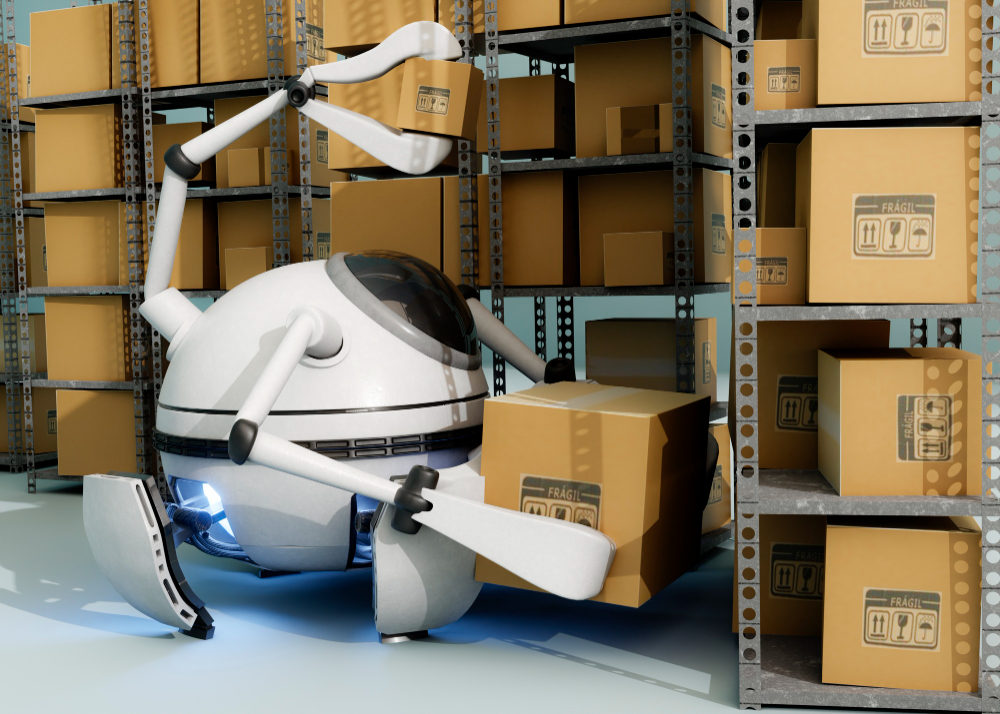
The floor of the SHV1 fulfillment center in Shreveport, Louisiana, is not like most American warehouses. Squat robotic platforms, which resemble enormous hockey pucks, move towers of inventory pods across a massive floor with silent efficiency, delivering goods to stationary human workers who pick and pack items without ever having to walk the long distances that characterized warehouse work ten years ago. It’s tidy. It moves quickly. Additionally, it has 1,133 employees.
Comparable Amazon fulfillment centers have up to 3,000 square feet of space. Investor calls and press releases frequently cite SHV1, Amazon’s most automated facility, as a prototype for the company’s future warehouse network. The difference between 1,133 and 3,000 is the most truthful figure in the whole automation narrative.
Amazon’s global logistics network now employs over 750,000 robots, up from about 200,000 in 2019 and 520,000 in 2022. Over 75% of customer orders are now completed with the help of these machines, according to the company. The Tipper, which automatically unloads packages from employee carts to conveyor belts, the six-sided scanner, which records package information without manual handling, and the Vulcan robot, a picking and stowing arm with force-feedback sensors that enable it to handle items in pod compartments without damaging them, including the upper rows that previously required workers to climb step ladders, were among the new systems that Amazon unveiled in a European facility in Dortmund, Germany, in May 2025.
| Category | Details |
|---|---|
| Company | Amazon.com, Inc. |
| CEO | Andy Jassy (since July 2021) |
| Total Employees (2024) | ~1.56 million (down from 1.61 million in 2021) |
| Current Robot Deployments | 750,000+ (up from 200,000 in 2019/2020) |
| Robot Share of Orders | Over 75% of customer orders involve robotic assistance |
| Automation Cost Reduction | 25% reduction in warehouse fulfillment costs |
| Projected Job Avoidance (by 2027) | 160,000+ U.S. positions not hired due to automation |
| Fulfillment Center Employment Decline | Most automated centers: ~10-25% drop in headcount (2022–2024) |
| Most Automated Facility | SHV1, Shreveport, Louisiana — 1,133 employees (comparable facilities: 3,000+) |
| Key New Robots | Vulcan (picking/stowing), Tipper (unloading), Sequoia, Digit (bipedal) |
| Workers Upskilled | 700,000+ through Amazon training programs |
| Worker Retraining Programs | Yes — focused on higher-skill roles working alongside robotics |
| Reference Website | About Amazon – Operations |
According to Nicola Fyfe, VP of logistics at Amazon in Europe, the initiative aims to produce “more high-skilled work that is ergonomically sound.” During a February earnings call, CEO Andy Jassy stated that the business had “already gotten a significant amount of value out of our robotics innovations.” Value is a word of caution.
The company’s official stance, which is consistently reiterated, is that robots create new jobs rather than eliminating existing ones. Automation creates new job categories while reducing walking distances and heavy lifting, according to Stefano La Rovere, director of global robotics at Amazon, who spoke with CNBC. “700 new categories of jobs” brought about by technology have been mentioned by Amazon.
Additionally, it has trained more than 700,000 employees in higher-skill programs; this number is repeated enough times in press materials to imply that they are aware of how the conversation would appear without it. In a way, all of this might be true. It’s also true that Amazon has claimed to have cut expenses by 25% thanks to warehouse automation, but there is really only one source of such savings.
The picture becomes clearer when occupational safety data is examined more closely. The average workforce at Amazon’s Robotics Sortable facilities, which are its most automated fulfillment centers, decreased by more than 10% in just two years, from roughly 3,634 to 3,256 between 2022 and 2024. The decline was 16% at conventional sortable fulfillment facilities. 12% at facilities with large items. Amazon delivered 20% more packages overall during that time, and employment at delivery stations increased proportionately. When they handle more packages, the delivery stations—which are not robotically transformed—need more workers to load packages onto trucks.
The automated fulfillment centers don’t. Instead of creating more jobs at fulfillment centers, the productivity increase went to the robots. According to Benjamin Y. Fong, associate director of Arizona State University’s Center for Work & Democracy, fulfillment centers would have employed about 25% more people by 2024 if they had scaled their workforce the same way delivery stations did. Real people who weren’t hired are represented by that gap.
Amazon’s automation team anticipates avoiding hiring more than 160,000 employees in the United States that it would otherwise need by 2027, according to internal documents obtained by The New York Times in late 2025. Savings: about 30 cents for each item processed. The company now employs almost 1.2 million people in the United States, having tripled since 2018. However, this growth is not due to the fulfillment centers where automation is most prevalent and significant, but rather to the massive expansion of the larger logistics and delivery operation.
It’s difficult to ignore the fact that this is a genuinely complex story presented in an easy-to-understand manner. The logistics network of Amazon is a marvel of operational engineering, and the desire for robots to perform heavy lifting in place of human workers is not cynical. The ergonomics argument is legitimate. The safety improvement argument is also valid. The Senate report from 2024 that claimed that Amazon warehouses created a “uniquely dangerous” environment for workers—a claim that Amazon disputes—does not stand alone. Robotic assistance actually lowers some of the risks associated with warehouse injuries at Amazon facilities, which have been a documented concern for years.
However, a business may take actions that both enhance working conditions and decrease employment. The data that is currently available indicates that both of those statements are true at the same time, and they are not mutually exclusive. Within the next few years, Amazon is expected to install over a million robots in its network; the company’s own press releases have referenced reaching this milestone. Over the next several years, the Vulcan robot is expected to be widely deployed in American and European facilities. According to a late 2024 document cited by Business Insider, Vulcan and similar devices are essential to “flattening Amazon’s hiring curve over the next ten years.” It has nothing to do with creating jobs. That speaks to the floor and direction of future employment growth.

Follow Live Media News on Google News
Get Live Media News headlines in your feed — and add Live Media News as a preferred source in Google Search.
Stay updated
Follow Live Media News in Google News for faster access to breaking coverage, reporting, and analysis.
- Search any trending topic on Google (for example: Greece news).
- On the results page, find the Top stories section.
- Tap Preferred sources and select Live Media News.