


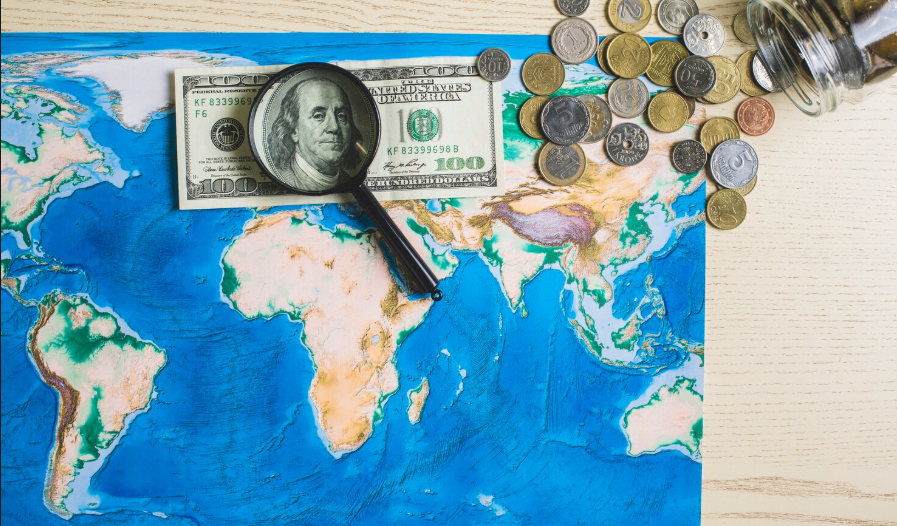
Holding a dollar bill and knowing that it will soon become obsolete is a subtly unsettling experience. The announcement last week by the U.S. Treasury regarding the redesign of the Catalyst Series currency carried a weight that doesn’t fully sink in until you’re standing at a register, taking out a twenty, and wondering how long that familiar green face will be staring back at you.
The United States will start its most comprehensive reform of paper money in over a century in late 2026. The $10 bill is introduced first, and then it will be phased in every two years until 2034. Since planning for this started in 2011, more than fifteen years of meticulous, quiet preparation have finally come to light. Such a timeline reveals something about the scope of this endeavor. It’s not a refresh. It is a reimagining.
| Category | Details |
|---|---|
| Organization | U.S. Department of the Treasury / Bureau of Engraving and Printing (BEP) |
| Initiative Name | Catalyst Series — U.S. Currency Redesign Program |
| Announced By | Treasury Secretary Scott Bessent |
| First Denomination | $10 Bill (Alexander Hamilton) — Late 2026 |
| Rollout Schedule | $10 (2026), $50 (2028), $20 (2030), $5 (2032), $100 (2034) |
| Planning Started | 2011 |
| Last Major Redesign | 2013 ($100 Bill) |
| Key Features | Tactile accessibility, advanced UV/IR security, machine-readable covert features |
| Notable Change | Trump’s signature replacing the Treasurer’s — first sitting president on legal tender |
| Estimated Counterfeit in Circulation | $70 million – $200 million |
| Reference Links | U.S. Treasury Department / Bureau of Engraving and Printing |
Using ceremonial language, Treasury Secretary Scott Bessent has described the launch as a moment of national strength and linked it to America’s 250th anniversary. Beneath that patriotic rhetoric, however, is something much more realistic and, to be honest, long overdue: the recognition that U.S. currency has been lagging behind.
Tactile features for people with visual impairments have been available for years in other developed economies. Some have added covert security layers that are machine-readable, something that American bills just lack. That disparity has become increasingly difficult to defend for a nation that regards the dollar as the global reserve currency.
It’s not just the new appearance that makes this redesign truly noteworthy. It is the underlying security architecture. Improved UV-reactive threads, infrared signature profiles, and hidden features that are only readable by bank-grade sensors—invisible to the human eye and undetectable by outdated equipment—will be included in the new notes.
For months, the Bureau of Engraving and Printing has been subtly warning financial institutions that the new bills will be difficult for legacy currency counters to authenticate. Businesses may find themselves in a difficult situation if they don’t upgrade their cash-handling infrastructure by 2026: they will have to reject genuine new currency while still being susceptible to sophisticated counterfeits.
Although the exact timing of the new $10’s widespread circulation is still unknown, the mixed-currency period, during which old and new bills coexist, may last up to ten years. Retailers, banks, and anybody else handling large amounts of cash on a daily basis face significant operational complexity as a result. A few of them are already observing. Most likely, others aren’t.
Then there’s the detail that has garnered the most attention, which makes sense. The first time a sitting president’s name has appeared on legal tender, Donald Trump’s signature will be on US paper money. For the first time since 1861, the Treasurer’s signature is being removed to create space. This is being presented by the Treasury as a remembrance of the country’s semiquincentennial.
Opponents interpret it differently, seeing it as yet another example of Trump endorsing organizations that have traditionally maintained a distance from his presidential identity. One of the things that makes this moment so peculiar to witness is the possibility that both readings could be true at the same time.
In June, the first $100 bills bearing the signatures of Bessent and Trump are anticipated to come off the presses. There is a certain irony in the fact that while the deeper security changes will subtly alter every cash transaction that takes place at gas stations, grocery stores, and small businesses across the nation, the most politically visible change—the signature—arrives on a denomination that most Americans hardly ever handle in daily life.
It’s difficult to ignore the fact that everyone will be watching this closely. The rise of digital payment systems and international efforts to lessen reliance on dollar-denominated trade have put increasing pressure on the dollar’s dominance in the world economy in recent years. If done correctly, a redesign of this magnitude might boost trust in the infrastructure supporting US currency.
If it is implemented poorly or too quickly for institutions to adjust, it may cause the exact kind of conflict and misunderstanding that undermines trust.
Here, the Treasury has legitimate goals. The security advancements are justifiable and long overdue. Until those new $10 bills are actually passing through cash drawers in late 2026, the question of whether the execution aligns with the vision will remain unanswered. The dollar is currently fluctuating. That much is for sure.

Follow Live Media News on Google News
Get Live Media News headlines in your feed — and add Live Media News as a preferred source in Google Search.
Stay updated
Follow Live Media News in Google News for faster access to breaking coverage, reporting, and analysis.
- Search any trending topic on Google (for example: Greece news).
- On the results page, find the Top stories section.
- Tap Preferred sources and select Live Media News.