


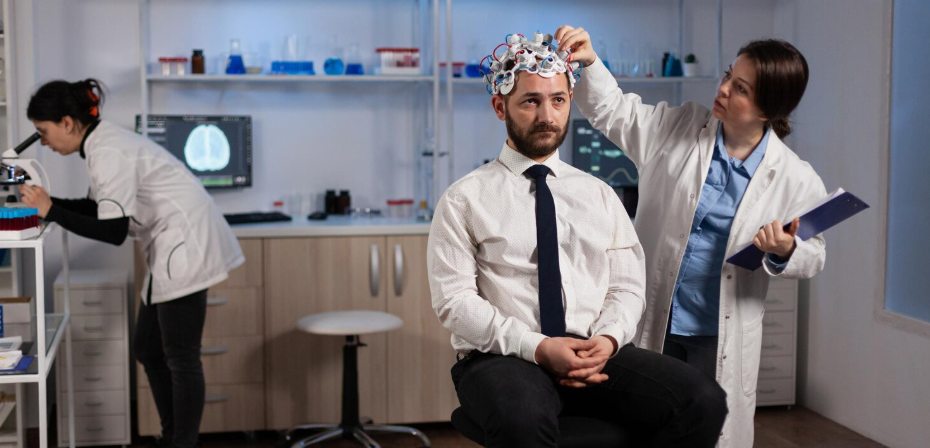
Neuroscience spent years pursuing a well-known goal: to map the brain, one area at a time, until thought itself could be explained. The amygdala here, the prefrontal cortex there. A neat mental diagram. However, the atmosphere in many contemporary neuroscience labs feels a little different. Brain scans continue to light up screens, but the discussions become more cluttered. Stress. Conduct. pressure from the real world. The idea that the brain only really shows itself when it is under stress is getting harder to ignore.
For instance, while volunteers complete stressful tasks in a University of North Carolina research building, psychologists and neuroscientists frequently observe colored patterns ripple across imaging monitors. The only sound in the room is the hum of the cooling fans. Someone doesn’t complete a task. A person is unsure before making a decision. Abruptly, the brain illuminates—not just one area, but whole networks.
| Category | Details |
|---|---|
| Field | Neuroscience & Psychology |
| Core Focus | Understanding behavior and brain function under stress |
| Key Researchers Mentioned | Kristen A. Lindquist, Thalia Wheatley, Uri Hasson, Kerry J. Ressler |
| Key Institutions | UNC Chapel Hill, Dartmouth College, Princeton University, Harvard Medical School |
| Research Methods | Neuroimaging, brain connectivity studies, genetic risk scoring, behavioral experiments |
| Major Concepts | Brain connectivity, social brain synchrony, stress response, neuroplasticity |
| Practical Applications | Mental health treatment, anxiety therapy, behavioral prediction |
| Example Study | Writing about past failures reduces cortisol during stressful tasks |
| Official Reference | https://www.apa.org |
Kristen A. Lindquist, a neuroscientist and psychologist at UNC Chapel Hill, has been studying these trends for years. The previous method frequently searched for discrete brain activity, such as one region linked to fear and another to judgment. However, real behavior is rarely so orderly. When dieters see chocolate, their pleasure centers light up, but the prefrontal cortex also kicks in, subtly attempting to enforce self-control. Observing the interactions between these areas reveals more than just a mental map. It turns out that the brain functions more like a dialogue than a control panel.
A new avenue has been made possible by the move toward researching connectivity, or the communication between different parts of the brain. Researchers are focusing on how the brain responds to problems rather than what it believes. difficult decisions. emotional dangers. peer pressure. times when actions become apparent. This may be the most honest part of neuroscience.
Think about a brief but fascinating memory and stress experiment. In one study, participants were asked to write about their own shortcomings. The assignment was not enjoyable. As participants stared at blank pages and recalled embarrassing errors or setbacks, the room probably felt a little heavy. The researchers then presented a demanding assignment.
An intriguing event occurred. People who had written about their past failures made more thoughtful choices and had lower levels of the stress hormone cortisol. Their bodies reacted as though the stress were less dangerous. The brain had been silently primed by writing about failure. The outcome begs the question of how experience influences brain activity long before we are aware of it.
Psychologists have been debating how thoughts affect behavior for decades. Nowadays, a lot of researchers appear to be more interested in the opposite: how relationships, stress, and environments affect the brain itself.
Numerous brains are studied simultaneously in some of the most intriguing research. Neuroimaging has been used by Princeton’s Uri Hasson and Dartmouth’s Thalia Wheatley to study human communication. In some experiments, two subjects are placed inside scanners and given the same story to listen to. They start to synchronize their brain activity. It’s almost unsettling. Through dialogue, two minds come into alignment.
Before hearing a story, participants in one study were given slightly different interpretations of it. These interpretations were reflected in their brain patterns. In a subtle way, the implication is unnerving: the information we take in may subtly match our brain reactions to those of people around us. It appears that groupthink may be neurological in nature.
It’s difficult to ignore how social and environmental factors permeate the brain’s wiring as these experiments take place. Neural responses from friends are frequently remarkably similar. Brain activity can be synchronized through conversation. Emotional circuits are reshaped by stressful events. The brain is not as isolated as previous models proposed. It continuously takes in the world.
Another level of complexity is added by genetics. Polygenic risk scores are the result of recent genome-wide studies that look at thousands of genes simultaneously. These scores can be used to predict a person’s propensity for certain behaviors, such as substance abuse, aggression, and impulsivity. However, genes by themselves seldom determine the result.
Children with genetic risk factors for aggressive behavior exhibited wildly disparate results based on their surroundings in one extensive study. Later in life, those who received a structured family intervention showed significantly fewer behavioral issues. In other words, the wiring in the brain is flexible. One of the most subtly optimistic concepts in neuroscience is still neuroplasticity.
Nevertheless, the field advances with a startling degree of hesitancy in spite of all this progress. Many medical professionals are still hesitant to use neuroscience directly in treatment. Some are concerned that the results are too preliminary. Others worry that patients might interpret brain explanations as fate. It makes sense to be concerned.
However, as the body of research grows, it seems as though neuroscience is progressively leaving the lab and entering everyday life. Social brain imaging, therapy research, and stress tests all imply that the brain is more about adaptation than static thought. Under pressure, behavior reveals patterns that are hidden by regular thought.
It’s hard not to sense a quiet shift taking place as you stand outside one of these research labs and watch students nod off after lengthy scanning sessions. It was once claimed that neuroscience could explain thought. Eventually, that promise might still materialize.
For the time being, however, the true insights seem to come when the brain is thrown a little off balance. The mind begins to tell the truth when stress enters the room.

Follow Live Media News on Google News
Get Live Media News headlines in your feed — and add Live Media News as a preferred source in Google Search.
Stay updated
Follow Live Media News in Google News for faster access to breaking coverage, reporting, and analysis.
- Search any trending topic on Google (for example: Greece news).
- On the results page, find the Top stories section.
- Tap Preferred sources and select Live Media News.