


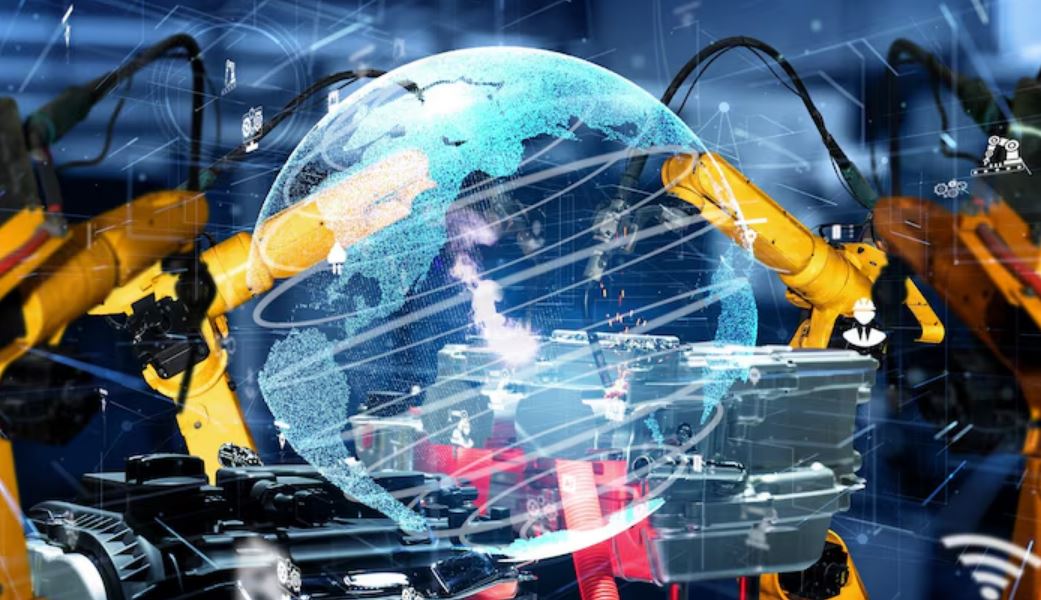
On the outskirts of Frankfurt last September, executives gathered beneath bright exhibition lights to discuss something that felt quietly monumental. According to the International Federation of Robotics, more than 4.6 million industrial robots are now operating worldwide. That number, up 9% from the previous year, is large enough to feel abstract. But standing inside a factory where robotic arms swing in disciplined arcs, welding car frames in bursts of blue light, the scale becomes physical. Audible. Slightly unsettling.
It’s possible that we are underestimating what this surge really means.
Investors certainly are not. Venture capital funding for robotics hit $8.8 billion in a single quarter in 2025, according to Barclays research—a 15-fold increase compared to 2017. That kind of acceleration usually belongs to software. This time, it’s hardware. Heavy, mechanical, expensive hardware. Watching money flow back into factories, actuators, and battery systems feels like a reversal of the asset-light era Silicon Valley once glorified.
| Category | Details |
|---|---|
| Organization | International Federation of Robotics (IFR) |
| Founded | 1987 |
| Headquarters | Frankfurt, Germany |
| Focus | Global robotics data, research, and industry standards |
| 2024 Global Robot Stock | 4,664,000 industrial robots in operation |
| 2024 Installations | 542,000 units installed globally |
| Key Insight | 9% year-over-year increase in operational robots |
| Official Website | https://ifr.org |
Asia is driving much of this momentum. China alone accounted for more than half of global industrial robot deployments in 2024, installing nearly 300,000 units in a single year. When tourists stroll through Shenzhen or Suzhou’s manufacturing districts today, they describe production lines humming with locally manufactured machinery—Chinese brands are now outselling foreign rivals domestically. Long-term national funding plans spanning decades seem to support investors’ belief that this is a structural shift rather than a transient spike.
The US is investing in a different way in the meantime. NASA robotics programs, DARPA challenges, and defense budgets are not headlines that appeal to consumers, but they are influencing the development of the next generation of autonomous systems. With valuations that would have seemed ridiculous five years ago, Silicon Valley startups are pursuing humanoid robots. According to reports, Figure AI is aiming for a valuation of almost $40 billion. When capital becomes plentiful, it is difficult to ignore how quickly skepticism diminishes.
Europe is in a more difficult situation. Despite a slight decline, Germany continues to be the industrial hub of the continent, installing almost 27,000 robots last year. Robotics companies in Munich and Stuttgart discreetly improve high-precision parts, the mechanical “brawn” that humanoids rely on. A significant portion of the global actuator supply chain is controlled by Europe. However, there is a perception that commercialization may be slowed by fragmented funding and regulatory caution. It’s unclear if that restraint turns out to be prudent or expensive.
The humanoid question comes next. In a worst-case scenario, investment banks estimate that the humanoid market could grow to $40 billion by 2035; more optimistic estimates are much higher. Production costs have fallen dramatically over the past decade, dropping from millions per prototype to closer to $100,000 per unit for some systems. Humanoids stood erect in fluorescent lighting at trade exhibitions earlier this year, grasping tools and reacting to spoken cues. The demonstrations were impressive. A little bit choreographed as well.
When these devices will function consistently in chaotic, real-world settings is still unknown. The floors of factories are organized. Construction sites, farms, and hospitals are not.
However, demographic pressure is advancing the discussion. Industrial labor pools are getting smaller due to aging populations in East Asia and Europe. Younger workers are hard to come by in agricultural areas. Warehouses are expanding faster than hiring pipelines can accommodate. In such conditions, robots begin to look less like luxuries and more like insurance policies.
Mobile robots already dominate revenue within the broader robotics market, especially in logistics. Warehouses increasingly resemble carefully orchestrated ballets of autonomous carts gliding across polished concrete floors. Software layers, managing perception and motion control, are becoming as valuable as the hardware itself. By 2030, analysts predict that revenue from robotics software alone will surpass $24 billion. That change seems to be the true turning point—the integration of AI with mechanical systems.
However, beneath the optimism are tensions. Within decades, AI-powered robots may surpass human workers, according to a recent warning from a former Citi executive. CFOs who are staring at growing wage costs find payback periods, sometimes expressed in weeks rather than years, to be alluring. There is a subtle unease in those computations. Executives seldom discuss the potential difficulties faced by displaced workers when discussing “cost structures” that shift from labor to capital expenditure.
As this develops, it seems that the robotics boom is more about economic pragmatism than futuristic spectacle. Because robots are appealing, businesses are not investing. They are investing because labor is in short supply, margins are narrow, and reshoring of production is encouraged by geopolitical unpredictability. Overtime is not necessary for robots. They don’t form unions. Their depreciation is predictable.
However, historical evidence indicates that technological waves seldom follow a straight path. Europe saw a decline in installations last year. There was a slight decrease in the Americas. Conflicts, trade disruptions, and uncertain growth projections are examples of macroeconomic headwinds that continue to cast long shadows. Despite its resilience, the robotics industry is not impervious.
Analysts predict that the global robotics market could surpass $110 billion by 2030, more than doubling its size from 2024. Before the decade is out, installations are predicted to exceed 700,000 units per year worldwide. Those numbers sound assured. Nearly inevitable.
However, one is reminded that technology does not eliminate uncertainty when strolling through a contemporary factory, where sparks fly, machines glide, and people watch from behind glass. It rearranges it.
The global investment surge in robotics is real. Tangible. Expanding.
Whether it ushers in abundance, disruption, or something more complicated will depend not only on engineering breakthroughs or venture capital enthusiasm, but on how societies choose to adapt alongside the machines now quietly multiplying in their midst.

Follow Live Media News on Google News
Get Live Media News headlines in your feed — and add Live Media News as a preferred source in Google Search.
Stay updated
Follow Live Media News in Google News for faster access to breaking coverage, reporting, and analysis.
- Search any trending topic on Google (for example: Greece news).
- On the results page, find the Top stories section.
- Tap Preferred sources and select Live Media News.