


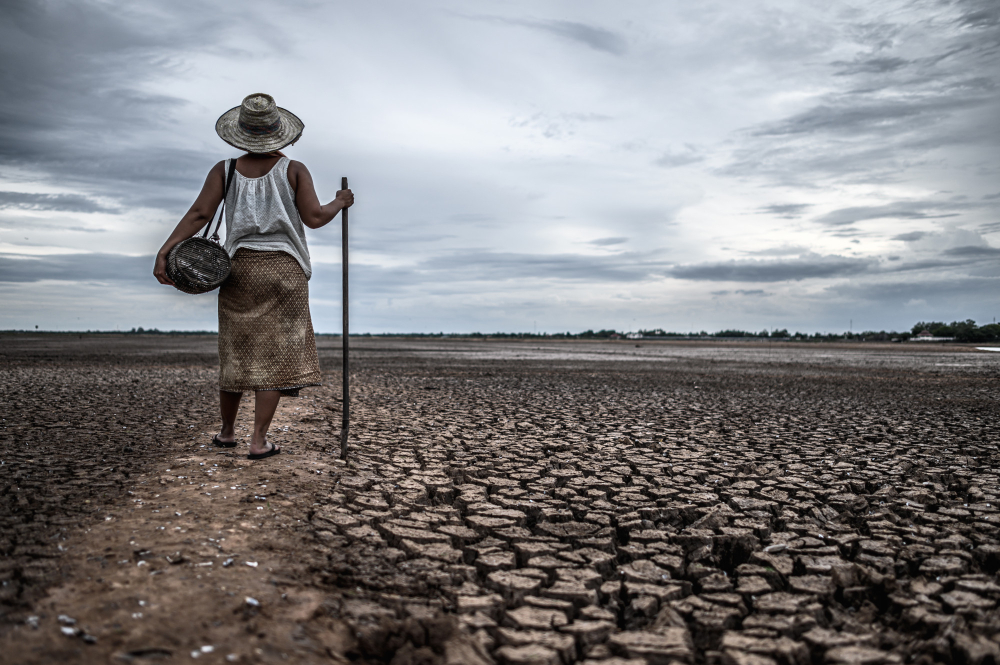
At first glance, the land doesn’t appear completely dead. There are still remnants of life in some areas of the Sahel, such as stubborn grass patches and a few sporadic trees that bend in the dry wind. However, the illusion disappears as you go a little farther. What was once farmland starts to resemble something more akin to abandonment as the ground cracks beneath your feet. This is where the story of climate migrants subtly starts.
Communities in Sub-Saharan Africa have depended on regular seasons for decades. Animals would graze, crops would grow, and rain would fall. That dependable but flawed rhythm has begun to falter. Droughts last longer. Rainfall is either nonexistent or arrives late. It’s possible that the entire basis of rural life is changing, not just the climate.
| Category | Details |
|---|---|
| Topic | Climate Migration & Desertification |
| Region | Sub-Saharan Africa (Sahel, East & West Africa) |
| Key Drivers | Drought, water scarcity, land degradation |
| Estimated Impact | Up to 86 million internal migrants by 2050 |
| Major Sectors Affected | Agriculture, livestock, rural livelihoods |
| Vulnerable Groups | Women, children, rural communities |
| Key Organizations | UNHCR, World Bank, African Union |
| Type of Migration | Internal displacement & cross-border migration |
| Current Trend | Increasing rural-to-urban movement |
| Reference | https://www.worldbank.org |
A dry riverbed spans the country like a scar in northern Kenya. This place used to have water. Cattle used to congregate at its edge, and locals still point to it. Families now pack what they can, including some cooking utensils, rolled-up bedding, and plastic containers, and head out. Not in a big way. Just steadily. In this situation, migration feels more like a silent surrender than a choice.
The core of this change is agriculture. Many people rely on small-scale farming, which is frequently directly correlated with rainfall. Everything else—income, food security, and stability—follows when that fails. Millions may be displaced in the upcoming decades, according to studies, but statistics don’t fully convey the complexity of the situation. It goes beyond simple movement. It’s disruption, developing gradually but unrelentingly.
Tension over resources is also increasing. The declining water levels in the areas around Lake Chad are now more than just an environmental problem. There is sometimes violent competition between farmers and herders for what is left. Although it’s still unclear where conflict ends and climate begins, the two appear to be becoming more intertwined and feeding off one another in ways that are challenging to distinguish.
Meanwhile, the effects are being felt in urban areas. Cities like Lagos and Nairobi are growing quickly, and informal settlements are sprouting up on their outskirts. Heat from the afternoon sun is reflected by corrugated metal roofs that stretch across dusty hillsides. Arriving in search of opportunity, people frequently discover something more complex, such as cramped housing, sporadic employment, or a different kind of uncertainty.
The initial arrival of migrants in these cities is a moment that is frequently disregarded. They stop and listen to the strange noise, the density, the pace, the traffic. It’s difficult to ignore how different it feels from the open areas they left behind. There is a strain associated with the transition from rural peace to urban congestion.
A disproportionate amount of that burden appears to fall on women and children. Access to healthcare and education becomes unequal in informal neighborhoods or displacement camps. Daily schedules vary. Once-educated girls now spend hours gathering water or assisting their families in adjusting to new circumstances. For many, there’s a feeling that these moments are subtly reshaping the future.
However, migration isn’t always portrayed as a failure. It is referred to by some policymakers as adaptation—a necessary reaction to shifting circumstances. There is some logic to that concept. After all, adapting to survive is a type of resilience. However, it also poses awkward queries. When does adaptation turn into displacement? And who makes the distinction?
The reaction has been inconsistent throughout the world. Legal frameworks are still lagging behind organizations like the World Bank and the United Nations High Commissioner for Refugees that have started taking a more direct approach to climate migration. The current definitions of refugees do not adequately describe climate migrants. They are visible but not entirely acknowledged, existing in a sort of gray area.
The wider imbalance must also be taken into account. Despite making a comparatively small contribution to global emissions, Sub-Saharan Africa suffers some of the worst effects. Although this discrepancy is frequently recognized, it is rarely addressed. There is money available for adaptation projects, but not always at the necessary pace or scale. Perhaps the world is reacting, but not fast enough.
As this develops, it seems that one of the key narratives of climate change is the slow, steady, and frequently undetectable movement of people. Persistent rather than dramatic or headline-grabbing in the conventional sense. quietly transforming entire regions, cities, and communities.
And people are still being propelled forward by the land, which is still cracking under the sun.

Follow Live Media News on Google News
Get Live Media News headlines in your feed — and add Live Media News as a preferred source in Google Search.
Stay updated
Follow Live Media News in Google News for faster access to breaking coverage, reporting, and analysis.
- Search any trending topic on Google (for example: Greece news).
- On the results page, find the Top stories section.
- Tap Preferred sources and select Live Media News.