


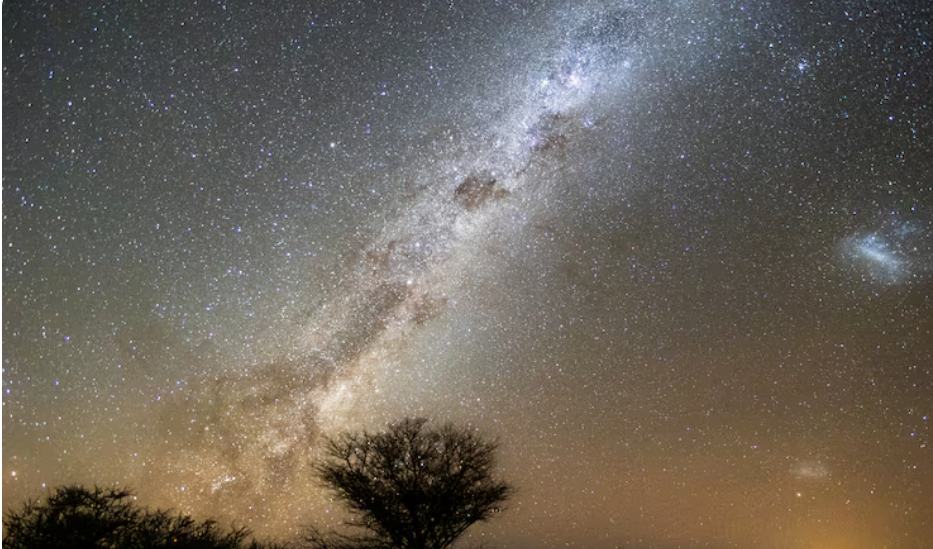
When astronomers look toward the Milky Way’s center, something peculiar occurs. The view becomes disorganized. chaotic. Almost everything is hidden by dust clouds. For many years, the center of our galaxy seemed more like a rumor than a map, with violent radiation, dense gas, and a supermassive black hole hiding somewhere in the shadows.
At least some of the fog has cleared now. The most detailed image of the central region of our galaxy has ever been created by astronomers using the Atacama Large Millimeter/submillimeter Array, a vast forest of radio dishes dispersed throughout Chile’s Atacama Desert. The enormous mosaic covers an area of sky about three full moons in width. A tangled web of gas filaments woven through space like glowing threads is revealed, revealing something surprisingly complex.
| Category | Details |
|---|---|
| Observatory | Atacama Large Millimeter/submillimeter Array |
| Survey Project | ALMA CMZ Exploration Survey (ACES) |
| Lead Scientist | Steven Longmore |
| Key Researcher | Ashley Barnes |
| Region Observed | Central Molecular Zone |
| Galaxy Studied | Milky Way |
| Observatory Location | Atacama Desert |
| Research Papers | Published in Monthly Notices of the Royal Astronomical Society |
| Data Portal | https://almascience.org |
| Image Scale | Region spanning about 650 light-years |
There’s an odd feeling when you stand back and gaze at the picture. Our galaxy’s center does not appear to be in order. It appears agitated. Before collapsing into dense knots, streams of cold molecular gas twist and converge to form long structures that span dozens of light-years. Scientists believe that new stars are silently forming in those knots.
The Central Molecular Zone is the area that astronomers are studying. It is located close to the supermassive black hole in the galaxy and is roughly 650 light-years across. In normal light, it is invisible. Everything is blocked by dust. However, radio telescopes such as ALMA are able to detect the faint signatures of molecules floating through space by seeing through that darkness.
The area is a place of extremes, according to astronomer Ashley Barnes of the European Southern Observatory. Although the data practically demands it, that phrase sounds dramatic. Temperatures change quickly. Magnetic fields are twisted and stretched. Clouds of gas crash into one another. Star formation typically follows a fairly predictable pattern in the galaxy’s more tranquil regions. Things seem less courteous here.
It’s possible that astronomers find the area so valuable precisely because of this chaos. Numerous molecules drifting through the gas were found by the ALMA CMZ Exploration Survey, or ACES. Some are easy. For instance, silicon monoxide. Others, such as organic molecules like acetone and methanol, are surprisingly complex.
Quiet questions concerning the early chemistry of galaxies are raised by observing these compounds floating through interstellar clouds. It’s difficult to ignore how recognizable some of those molecules are as you watch this happen. On Earth, they are found in labs. They also exist, for some reason, in enormous clouds that float around a galaxy’s center.
The image itself has a cosmic spiderweb-like appearance. The map is covered in cold gas filaments that feed material into dense clumps. The seeds of stars are those clumps. However, this is an exceptionally violent place. Many of the stars born in this area grow massive quickly, burning through their fuel and dying young, according to project leader Steven Longmore.
They also seldom have quiet endings. Supernovae are frequently the result of massive stars exploding. Sometimes even more spectacular events take place, such as hypernovae, which are explosions strong enough to change the shape of surrounding gas clouds. The area seems to be in a perpetual feedback loop, with stars forming, exploding, and stirring the gas that will eventually give rise to the next generation.
Before the survey started, astronomers believed they had a general idea of what to expect. After all, the center of the galaxy had been studied for decades. However, the finished mosaic showed something much more intricate than expected. Filaments exhibit nearly biological branching, intersection, and fragmentation.
Another scientist working on the project, Katharina Immer, acknowledged that the team was taken aback by how rich the structures were. That response conveys something. Strange images are nothing new to astronomers. However, the region’s actual complexity seemed to surprise even seasoned researchers.
However, whether these structures behave as predicted by theory is the deeper question. Studying calmer parts of galaxies was a major part of the development of star formation models. The Milky Way’s center is anything but serene. The density of gases is higher. Stronger radiation fields are present. The environment is slightly warped by the central black hole’s gravity. Whether stars adhere to the same rules here is still up for debate.
The data is valuable because of this uncertainty. Astronomers may need to reconsider how stars formed in the early universe if the models don’t work in this area. The chaotic conditions in the Central Molecular Zone, according to some scientists, are similar to those in young galaxies billions of years ago, when star formation rates were much higher. To put it another way, this untidy area close to the center of our galaxy may act as a time machine.
The narrative is not yet complete. The sensitivity of ALMA is being increased through an upgrade. Additionally, these structures should be able to be examined in even greater detail by the next generation of giant telescopes, such as the Extremely Large Telescope currently rising in Chile.
For the time being, however, the new picture seems to be the first authentic look into the crowded heart of the Milky Way. It’s not a neat star factory.
More akin to a cosmic storm, it continues to swirl and form stars in an unpredictable, violent, and quiet manner. And possibly gradually illuminating the origins of galaxies similar to our own.

Follow Live Media News on Google News
Get Live Media News headlines in your feed — and add Live Media News as a preferred source in Google Search.
Stay updated
Follow Live Media News in Google News for faster access to breaking coverage, reporting, and analysis.
- Search any trending topic on Google (for example: Greece news).
- On the results page, find the Top stories section.
- Tap Preferred sources and select Live Media News.