


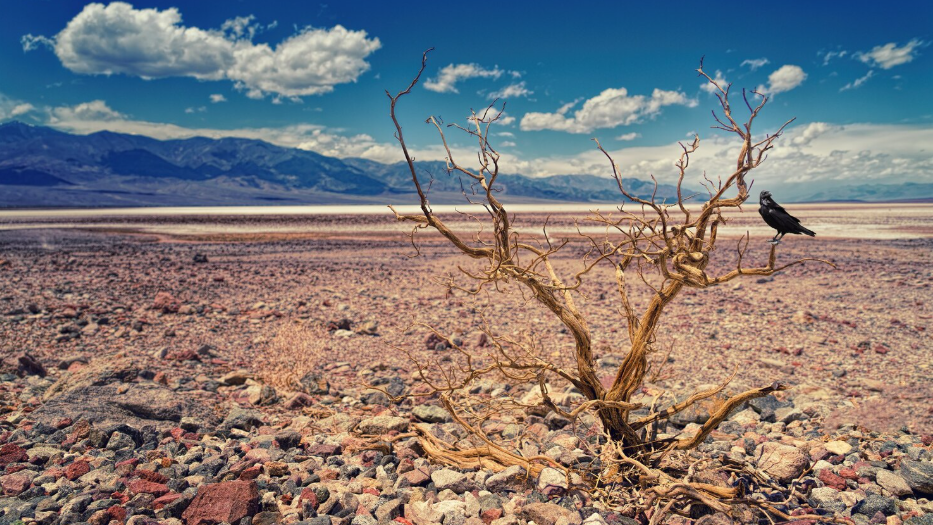
In the middle of summer in southern Spain, it is hard to avoid noticing the silence. The hills are still covered in neat rows of olive groves, but the ground beneath them frequently has a brittle, almost chalky appearance. Farmers discuss the soil in the same way that fishermen discuss the sea: they keep a close eye on it and can tell when something is off. Many of them also claim that the land feels different these days.
The sensation is real, according to scientists researching the growing drylands. Researchers have started mapping potential dry spots on Earth in the upcoming decades using high-resolution climate simulations from the Coordinated Regional Climate Downscaling Experiment. The findings convey a subtle but unsettling message: southern Europe is becoming one of the continent’s most vulnerable regions. In particular, Spain and Italy seem to be moving toward a semi-arid climate that is less Mediterranean.
| Category | Details |
|---|---|
| Phenomenon | Desertification and expanding drylands |
| Most Affected Region in Europe | Southern Europe, especially Spain and Italy |
| Key Scientific Program | Coordinated Regional Climate Downscaling Experiment |
| Key Climate Indicators Used | FAO-UNEP Aridity Index, Köppen-Geiger Climate Classification, Holdridge Life Zones |
| Projected Global Warming Levels | 1.5°C – 4°C scenarios |
| Potential Global Area Turning Arid | Up to 6.8 million km² at 4°C warming |
| People Potentially Affected | Up to 500 million globally in worst-case scenario |
| Major Drivers | Climate change, overgrazing, deforestation, unsustainable agriculture |
| Global Policy Framework | United Nations Convention to Combat Desertification |
| Reference Source | https://www.cordex.org |
Despite its dramatic name, desertification rarely happens overnight. It gradually takes hold, causing the soil to lose moisture, vegetation to thin, and water reservoirs to get smaller every year. It is typically described by scientists as land degradation in arid areas where ecosystems struggle to recover and fertile soil starts to disappear. Although it rarely acts alone, climate change is a significant factor. Aggressive farming methods, overgrazing, and deforestation frequently hasten the process and push landscapes past a tipping point.
One of the best illustrations of this subtle change can be found in Spain. Recent summers have seen temperatures in some areas of the nation approach 40°C, which has caused reservoirs to become shallow and fields to turn pale. Lately, April has been among the driest months since the early 1960s. Over 25% of the nation is reportedly suffering from severe drought conditions, according to the national weather agency. It’s difficult to ignore the pale rings of dried mud that indicate where water once was when passing a partially empty reservoir close to Córdoba.
Although Italy’s story appears somewhat different, there is still a hint of worry. Water shortages have frequently occurred in the Po River basin, which is typically one of Europe’s most productive agricultural areas. As crops struggle in the heat, farmers have seen irrigation canals shrink. Many agricultural communities believe that the seasons themselves are changing, coming earlier or staying longer than they used to.
These local observations could be a component of a broader global pattern, according to climate models. Scientists predict that about two million square kilometers of land could become newly arid even with a modest warming of about 1.5°C. When warming approaches 4°C, the area increases significantly to almost seven million square kilometers, which is equivalent to the seventh-largest nation in the world. One of those anticipated drying zones includes Southern Europe.
Still, there’s a certain scientific caution surrounding these projections. Aridity itself is hard to quantify, and climate systems are complex. Precipitation levels, evaporation rates, and ecological changes across landscapes are just a few of the indicators that researchers use. Accuracy is increased by combining several models, but uncertainties still exist. Changes in rainfall patterns may cause some areas to stabilize or even become greener. Rarely does nature move in a straight line.
However, policy experts are concerned about more than just the climate models. It’s the political hesitancy that occasionally envelops them. Even as droughts worsen, some Spanish leaders are doubting the seriousness of climate change, which has become intertwined with domestic politics. As the debate progresses, there is an odd contrast between the political discourse and the actual terrain—cracked soil making a silent argument of its own.
The effects on the economy are already becoming apparent. Spain produces about half of the world’s olive oil, so its droughts are more than just a local issue. Prices in international markets fluctuate when harvests decline. Customers first notice it when they are staring at suddenly pricey bottles of olive oil at the grocery store. Observing olives struggle to grow on heat-stressed branches, farmers become aware of it months before the harvest.
Desertification has deeper social ramifications than just agriculture. Migration patterns have historically changed due to water scarcity, and some researchers believe that growing drylands may eventually affect where people choose—or are compelled to—live. The extent of those changes is still unknown. However, the possibility persists, posing unsettling queries regarding the stability of environments that have long been thought to be stable.
Ironically, Europe hardly ever considers itself to be at risk of desertification. This issue is typically connected to Central Asia or the Sahara. However, the boundary between dryland and fertile land can shift—sometimes subtly, sometimes abruptly. It seems that Southern Europe is perched on that precarious edge.
Satellite maps of the Mediterranean basin start to show subtle trends, such as areas of land that are browning, rivers that are getting smaller, and reservoirs that are declining year after year. It doesn’t yet appear to be a desert. Not quite. However, there’s a feeling that the border is shifting across once-permanent landscapes, inch by inch.

Follow Live Media News on Google News
Get Live Media News headlines in your feed — and add Live Media News as a preferred source in Google Search.
Stay updated
Follow Live Media News in Google News for faster access to breaking coverage, reporting, and analysis.
- Search any trending topic on Google (for example: Greece news).
- On the results page, find the Top stories section.
- Tap Preferred sources and select Live Media News.