


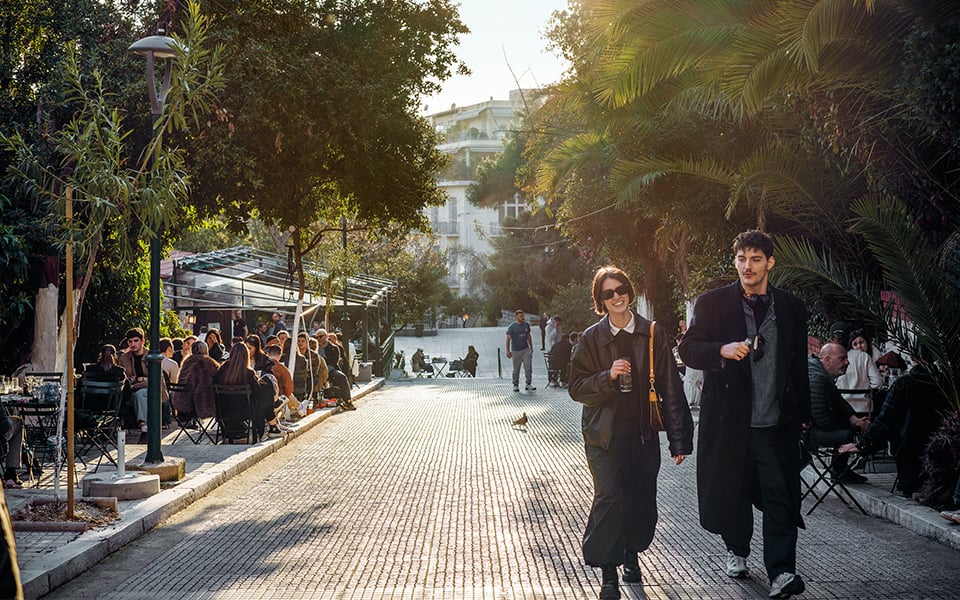
Dexameni Square in Athens’ Kolonaki neighborhood continues to serve as a vibrant social hub where residents and tourists gather for Sunday rituals amid layers of ancient and modern history. The traditional café and surrounding square have become synonymous with leisurely weekends, offering a village-like atmosphere in the heart of the Greek capital. According to recent observations, the Dexameni Square café attracts crowds every Sunday morning, with people claiming green metal chairs under shade or sun to enjoy everything from frappé coffee to fried calamari against the backdrop of the Acropolis.
The square’s unique charm stems from its blend of historical significance and contemporary life, with a Roman aqueduct reservoir at its center and the popular Cine Dexameni open-air cinema on its rooftop. On a typical Sunday, runners displaying race medals mix with children playing impromptu games, while families celebrate birthdays and regulars read newspapers at their favorite tables.
Historical Roots of Dexameni Square
The area’s history stretches back approximately two thousand years to Roman Emperor Hadrian, whose primary goal was supplying Athens with water. Hadrian’s Aqueduct remains one of the few Roman aqueducts in Europe still carrying water today, stretching about 25 kilometers from the foothills of Mt Parnitha and Mt Penteli to Kolonaki. According to research by Nikos Mamassis and Panagiotis Defteraios from the National Technical University of Athens, the nearly buried reservoir was uncovered in 1870 by Athens mayor Panagiotis Kyriakos and engineer Ioannis Genisarlis.
Maria Christaki, a researcher at the National and Kapodistrian University of Athens, notes that architect Ernst Ziller worked extensively on the water supply issue. The restoration of the aqueduct took eight years of successive repairs, requiring the reservoir to be covered with a dome and underground pipes installed for the new distribution system.
From Goatsville to Cultural Hub
Before becoming an intellectual gathering place, the area was known as “Katsikadika” or “Goatsville” until the mid-19th century. Goatherds and their flocks supplied the then-small city of Athens with fresh milk, occupying most of the land. The discovery of the Roman aqueduct forced the Municipality of Athens to purchase surrounding plots at double their estimated value.
Literary figures including Alexandros Papadiamantis, Odysseas Sikelianos and Angelos Sikelianos found inspiration in the neighborhood’s leafy setting and ancient past. Writer Kostas Varnalis recalled in his memoirs that Dexameni once had natural beauty without marble steps or stone walls, though the reality was likely less idyllic. The water supply system remained operational until 1940, while the iconic Cine Dexameni opened much later in 1991 as an initiative of the Cultural Center of Athens Water Supply and Sewerage Company.
Changing Community Dynamics at Dexameni
However, longtime residents and business owners report significant changes to the neighborhood’s character in recent years. Vasilis, owner of Bitzidis Uomo shop on the square for nearly twenty years, describes how the community has evolved. According to Vasilis, many historic shops including Rouga lighting fixtures, Aslanis and Parisis have closed, while numerous buildings have been converted to short-term tourist rentals.
Additionally, the sense of community that once defined the area has diminished as Airbnb properties replace long-term residents. Vasilis notes that faces change weekly and constant security presence has altered the neighborhood atmosphere, though he maintains a loyal clientele and continues operating thanks to a supportive landlord.
Architectural Diversity and Character
The square’s architectural landscape reflects multiple eras, with eclectic duplex houses meeting Bauhaus lines and neoclassical buildings standing alongside 1970s apartment blocks. Meanwhile, the upper end features modern buildings with dazzling white façades, while ground floors house trees, galleries and offices. The architectural timeline can be traced simply by observing the varying styles of shutters on different buildings.
In contrast to the changing demographics, some residents maintain deep connections to Dexameni. Christina, who played in the square as a child and later brought her own children there, describes it as “my village” and recalls when a clothing store called Mohnblümchen occupied a prominent corner building in the 1980s.
Sunday Rituals and Timeless Appeal
Regular visitors Yiannis and Sofia return to Dexameni frequently despite having moved away for practical reasons like parking. Sofia particularly appreciates the consistent sunlight, the summer open-air cinema, and the familiar café staff who provide reliable service. Simos, a ten-year resident, has actively resisted pressure to convert his apartment into a tourist rental, describing the neighborhood as having its own culture and distinctive cinematic light.
Magda notes that despite being in Kolonaki, Dexameni feels almost provincial due to the greenery, metal café tables and relaxed atmosphere. Lambrini observes that sunshine seems ever-present in the square, a sentiment confirmed by late afternoon sun still illuminating the space around six o’clock.
The future of Dexameni Square remains uncertain as tourism pressures and neighborhood gentrification continue reshaping its character, though longtime residents and regular visitors hope the unique village atmosphere within urban Athens will endure. The balance between preserving community identity and adapting to changing economic realities will likely determine whether Dexameni maintains its distinctive charm in coming years.

Follow Live Media News on Google News
Get Live Media News headlines in your feed — and add Live Media News as a preferred source in Google Search.
Stay updated
Follow Live Media News in Google News for faster access to breaking coverage, reporting, and analysis.
- Search any trending topic on Google (for example: Greece news).
- On the results page, find the Top stories section.
- Tap Preferred sources and select Live Media News.