


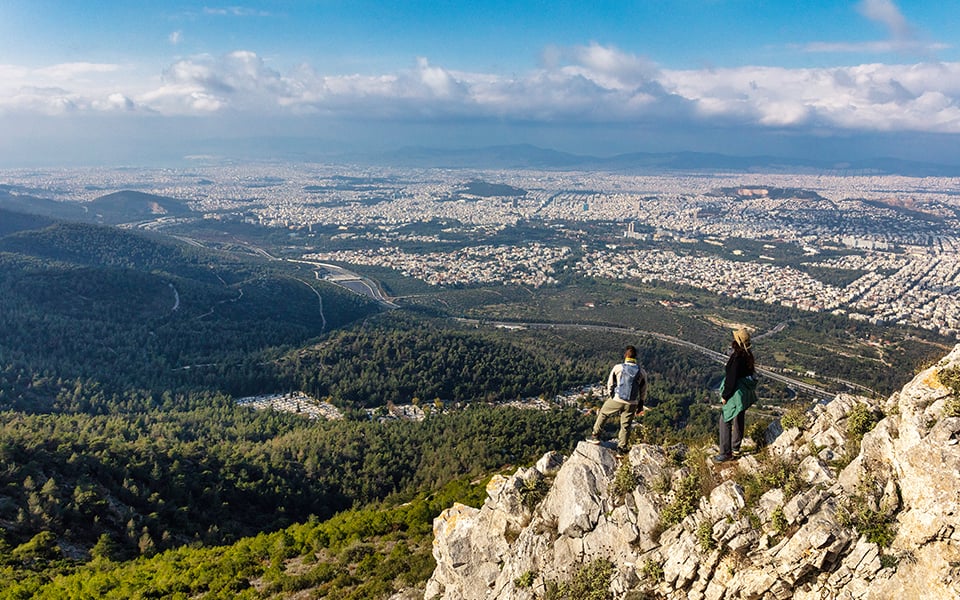
Mount Ymittos hiking trails near Athens are attracting a diverse mix of visitors seeking outdoor recreation and spiritual refuge just minutes from Greece’s capital. The mountain, rising 1,026 meters at its peak, has become a popular destination for families, mountain bikers, runners, and worshippers drawn to its nine historic monasteries. According to local guides, the trails of Mount Ymittos offer Athenians an accessible escape into nature without leaving the city limits.
Located on the eastern edge of the Attica Basin, the mountain features the Asteriou Monastery at 525 meters elevation, where Father Alexios and two other monks have revived religious life since 2013. The monk describes Mount Ymittos as “the Mount Athos of Athens,” referencing the nine monastic sites that spiritually encircle the ancient city.
Mount Ymittos Hiking Appeals to Multiple User Groups
The mountain’s appeal extends well beyond its religious significance. Every day, diverse groups converge on the trails: school groups guided by teachers, Gen Z mountain bikers treating the slopes as an informal downhill course, and urbanites using the forest for yoga and meditation. Mountain guides Stamatis Sotirchos and Giorgos Karvelas, working with Trekking Hellas Athens, report that visitors consistently cite the same motivation: seeking fresh air and natural scenery.
According to Father Alexios, the Asteriou Monastery stands on four ancient columns indicating it was built over the ruins of philosopher Diodorus’s school. The church itself was constructed by Saint Luke of Steiris, and the complex once featured a three-story defensive tower and underground passages allegedly connecting to Kaisariani Monastery and the Acropolis.
Rich Historical Layers Define the Mountain Landscape
The monastery’s history reflects Greece’s turbulent past. Until 1753, it answered directly to the Ecumenical Patriarchate before King Otto dissolved it as an independent institution in 1833 due to its small monastic population. By 1897, the monastery had fallen into complete disrepair and was eventually burned, according to historical records.
A 1930s renovation restored the monastery as a single-story structure. However, in the late 1950s, Queen Frederica assumed control of the complex, converting it into a summer residence and displacing three nuns who lived there at the time. Today, Father Alexios has revived traditional beekeeping practices, noting that Hymettian honey was long considered among Greece’s finest.
Ottoman-Era Structures Dot the Trail Network
Hikers on Mount Ymittos encounter the Tower of Anthousa, known by its Turkish name Koula, which has stood in ruins since 1722. Although documentation remains sparse, the guides indicate its architecture suggests Ottoman origin rather than Byzantine or Frankish construction. The tower likely served as a watchtower overseeing estates, a residence for local aghas, or a military outpost.
The terrain shifts constantly along the trails, with short ascents and descents through pine forests. Guide Giorgos Karvelas notes that prolonged drought intensified by climate change is taking a visible toll on the ecosystem. Warmer winters and reduced rainfall allow pests to persist longer, placing pressure on species such as the Greek fir.
Exceptional Biodiversity in an Urban Setting
Mount Ymittos supports remarkable botanical diversity for its size. Giannis Frydakis, head of Trekking Hellas Athens, reports that the mountain is home to more than 40 species of wild orchid, giving it one of the highest orchid densities relative to its area. Wild thyme, Jerusalem sage, and wild asparagus grow along the trails, creating aromatic corridors through the forest.
Additionally, the mountain provides panoramic views across the Attica Basin. From the 728-meter summit of Korakovouni, hikers can see the dense sprawl of Athens to the west and open plains stretching toward the airport to the east. According to the guides, on clear days visibility extends to the snow-covered peaks of Mount Parnassus.
Fire Recovery Demonstrates Natural Resilience
Young pines spreading across slopes near Korakovouni demonstrate the mountain’s recovery from a 2008 fire. Karvelas explains that pine trees possess unique adaptation mechanisms: some cones survive fires by bursting open and releasing seeds within days, while others lie dormant in soil for decades before emerging after fires. A damaged pine can reproduce within 15 years, he notes, describing the process as both efficient and resilient.
Meanwhile, informal trail markers called koukos—cairns of carefully stacked stones—guide hikers through unmarked sections. Before official trail markings existed, these structures served as primary navigation aids, with their name linked to Greece’s earliest mountaineering associations. Karvelas has the koukos symbol tattooed on his arm as tribute to this tradition.
The mountain continues to evolve as both a natural refuge and cultural landmark for Athens residents, with monasteries maintaining daily services while recreational users explore an expanding network of trails throughout the seasons.

Follow Live Media News on Google News
Get Live Media News headlines in your feed — and add Live Media News as a preferred source in Google Search.
Stay updated
Follow Live Media News in Google News for faster access to breaking coverage, reporting, and analysis.
- Search any trending topic on Google (for example: Greece news).
- On the results page, find the Top stories section.
- Tap Preferred sources and select Live Media News.