


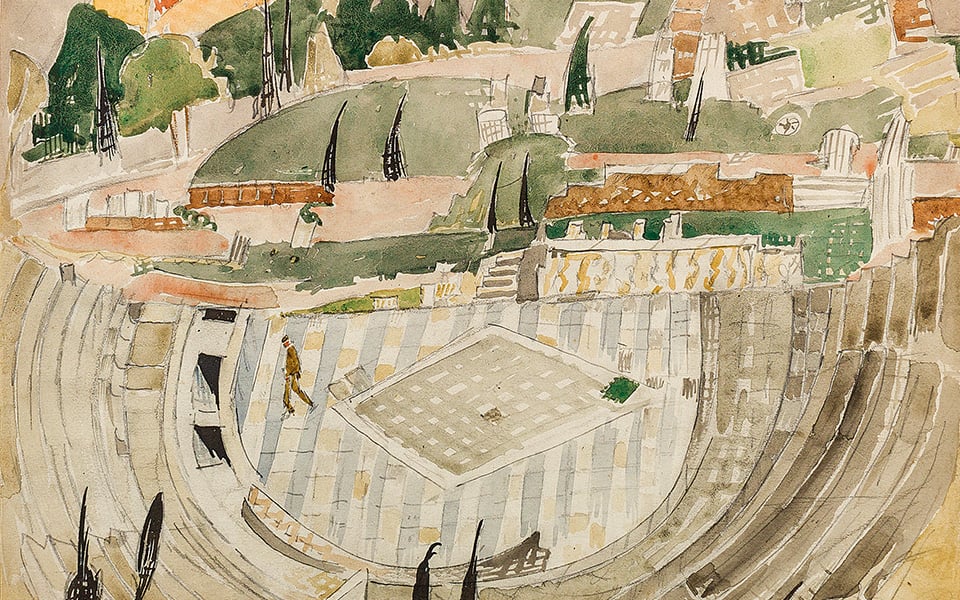
A major exhibition showcasing Ukrainian avant-garde artist Alexis Gritchenko has opened at the Museum of Modern Art in Thessaloniki, offering visitors a rare glimpse into how Greece appeared through a modernist lens in the early 1920s. The exhibition “Alexis Gritchenko (1883-1977), The Greek Adventure: A Ukrainian Avant-gardist in Greece” runs from November 22, 2025, through April 30, 2026, at MOMus-Museum of Modern Art in the Moni Lazariston complex. This retrospective traces the artist’s two-year journey across Greece, capturing ancient ruins, temples and landscapes in vibrant compositions that fused Fauvism, Cubism and Futurism with Byzantine artistic traditions.
According to the museum, Gritchenko traveled extensively from Athens to Mystras, Delphi, Olympia, Thessaloniki and various Greek islands between 1921 and 1923. His works from this period depict Greece’s iconic sites through bold geometry and explosive color palettes, representing a unique convergence of Eastern and Western artistic sensibilities.
The Artist’s Journey to Greece
Gritchenko’s path to becoming a Ukrainian avant-garde artist began with a formative trip to Paris in 1911, where he developed his distinctive visual language. Before arriving in Greece, he declined the prestigious directorship of Moscow’s Tretyakov Gallery in 1919, subsequently fleeing via Crimea to Istanbul and leaving behind his possessions. By 1921, he had settled in Greece, where the Mediterranean light and ancient heritage profoundly influenced his artistic output.
The exhibition demonstrates how Gritchenko bridged East and West through his visionary approach to depicting Greek antiquity. His work represents a unique moment when modernist experimentation met classical subject matter, according to curator Xenia Georgiadou.
Additional Cultural Offerings in Thessaloniki
Meanwhile, the city is hosting several concurrent exhibitions that complement the Gritchenko retrospective. The exhibition “Bringing History to Life,” co-organized by the Ministry of Macedonia-Thrace and the National Historical Museum, runs until February 28, 2026, at the Thessaloniki Administrative Building. This show transports visitors to the turbulent years of 1940-1944 through works including Kostas Grammatopoulos’s chromolithographs and Periklis Vyzantios’s painting “Mobilization in Delphi.”
Additionally, the Teloglion Foundation of Art is presenting “Techni – Diagonios and the Museum That Never Happened” until February 10, 2026. This exhibition marks the centenary of Aristotle University of Thessaloniki and features over 600 works from two landmark institutions that shaped the city’s cultural landscape from the 1950s to the mid-1990s.
Modernist Vision Meets Ancient Greek Heritage
The Gritchenko exhibition particularly highlights how the artist’s avant-garde training transformed his perception of Greek archaeology and landscape. His paintings from this period demonstrate an approach that departed from traditional romantic depictions of ancient Greece, instead applying modernist techniques to classical subjects. The works showcase his ability to capture Greece’s distinctive light quality while maintaining his experimental approach to form and color.
However, biographical details about Gritchenko’s specific travels within Greece remain limited in available documentation. The exhibition relies primarily on the visual evidence of his paintings to reconstruct his itinerary across the country during those two formative years.
Contemporary Context for Historical Art
In contrast to purely historical exhibitions, the Gritchenko show presents a Ukrainian artist’s perspective on Greece during a period of significant political upheaval in both nations. His status as a cultural refugee who rejected Soviet authority adds layers of meaning to his Greek works, according to art historians familiar with his career.
The exhibition’s timing coincides with renewed interest in Eastern European avant-garde movements and their international connections. Gritchenko’s fusion of Byzantine tradition with Western modernism represents an artistic dialogue that transcended national boundaries during the early twentieth century.
The exhibition will continue through late April 2026, with the museum indicating that educational programs and guided tours will accompany the show. However, specific programming details have not yet been announced by MOMus officials.

Follow Live Media News on Google News
Get Live Media News headlines in your feed — and add Live Media News as a preferred source in Google Search.
Stay updated
Follow Live Media News in Google News for faster access to breaking coverage, reporting, and analysis.
- Search any trending topic on Google (for example: Greece news).
- On the results page, find the Top stories section.
- Tap Preferred sources and select Live Media News.