


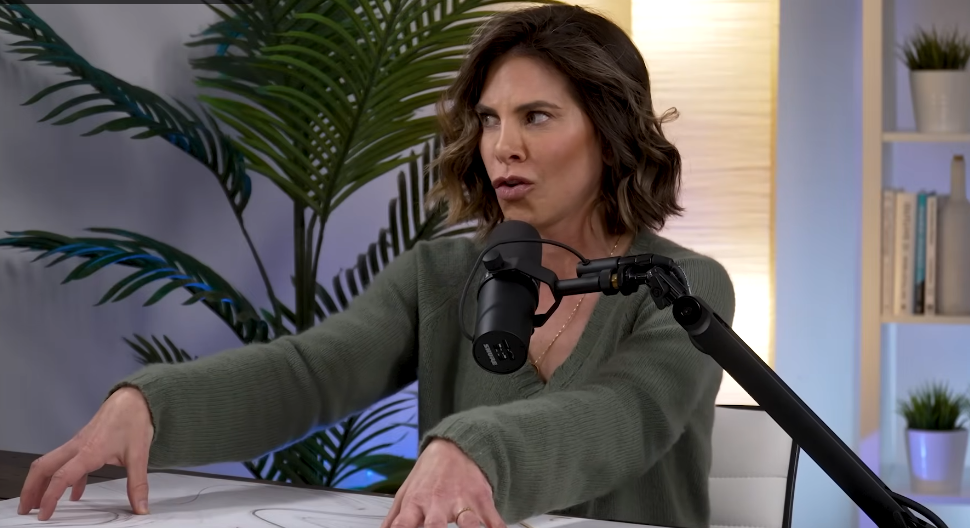
In a video that has gone viral on the YouTube channel Jubilee, Jillian Michaels sits opposite proponents of the body positivity movement and states unequivocally that obesity is unhealthy and that pretending otherwise endangers people’s lives.
The space becomes more constrained. The argument becomes heated. And Michaels, who has been debating this issue for more than 20 years, handles it with the unique poise of someone who has discovered that being uncomfortable during a conversation does not necessarily indicate that it is incorrect. As you watch it, you get the impression that she has shifted her attention from wanting to be popular to something she believes to be more significant.
| Full Name | Jillian Leigh McKarus (professionally Jillian Michaels) |
|---|---|
| Born | February 18, 1974, Los Angeles, California |
| Age | 52 |
| Occupation | Fitness trainer, nutritionist, author, media personality, businesswoman |
| Years Active | 2004–present |
| Known For | The Biggest Loser (NBC), fitness app, podcast “Keeping It Real” |
| Education | California State University, Northridge |
| Company | Empowered Media LLC (founded 2008) |
| Books Published | 9 books; 8 New York Times Bestsellers |
| Fitness App | Jillian Michaels: The Fitness App (Apple & Google award winner) |
| Spouse | DeShanna Marie Minuto (married July 2022) |
| Children | 2 (daughter Lukensia, son Phoenix) |
| Podcast | “Keeping It Real” (since February 2011); partnership with Bill Maher’s Club Random |
| Reference Website | Jillian Michaels Official Site |
Growing up in Tarzana, the San Fernando Valley, Jillian Michaels was an overweight child from a divorcing family. When her mother enrolled her in martial arts at the age of thirteen, more as a stress-reduction strategy than as a fitness intervention, something clicked—not just physically but also in terms of identity. Everything that followed was reorganized when the girl who had been turning to food as a coping mechanism realized that her body was capable of doing things she had never thought possible.
She worked as a personal trainer and bartender at California State University Northridge. In 2002, she opened a sports medicine facility in Beverly Hills. Two years later, she appeared on the set of The Biggest Loser, a new NBC reality show that would make her, for better or worse, the most well-known fitness trainer in America. Her age was thirty. She was completely unaware of what was about to happen.
Michaels had a huge platform and, ultimately, a huge issue thanks to The Biggest Loser. Since then, the show’s methods—rapid weight loss through severe calorie restriction and harsh physical training, carried out under camera lights and competitive pressure—have been documented in ways that reflect poorly on everyone involved, including Michaels, who has never completely denied her involvement in it but has also never seemed entirely comfortable defending it.
In recent years, an exposé documentary was broadcast. Previous competitors have discussed alleged mistreatment in public. The Biggest Loser model has mostly been abandoned by the fitness and nutrition communities in favor of strategies that prioritize long-term behavior change, mental health, and sustainability over dramatic before-and-after television moments. Depending on who you ask, Michaels’ continued presence, work, and arguments are either signs of perseverance or stubbornness. Maybe both.
The intriguing thing about her current situation in 2026 is that, contrary to what her detractors often claim, she takes a more nuanced stance on the body positivity controversy. Abbey Sharp, a registered dietitian who has publicly criticized The Biggest Loser’s tactics, found herself nodding along at the beginning of Michaels’s Jubilee debate.
Sharp, who has disassociated herself from body-positive rhetoric, admitted that there are actual, proven biological risks associated with excess visceral fat. Although she disagreed with Michaels on other issues, she affirmed that Michaels’ main assertion has a sound scientific basis. It implies that Michaels’s willingness to say uncomfortable things hasn’t completely outpaced the evidence supporting them, and that kind of partial vindication from an opponent is, in a sense, more credible than agreement from an ally.
Beyond the debate circuit, Michaels has established a company that functions on more levels than most people are aware. Both Apple and Google have recognized her fitness app as the best health and fitness app. Through a partnership with Bill Maher’s Club Random, she recently expanded her podcast, Keeping It Real, which she has been hosting since 2011, into video format.
This was a wise move to reach audiences who prefer long-form conversation over brief clips. Eight of her nine books have made the New York Times bestseller list. Her business, Empowered Media LLC, was established in 2008 and distributes content via on-demand services, hotel fitness channels, including Marriott and Hilton establishments, and streaming platforms. In other words, she has accomplished something that very few celebrities on television are able to do: outlive the show that brought her fame and create something strong enough to stand alone.
Her political development has drawn criticism of its own. After openly endorsing Robert F. Kennedy Jr.’s presidential campaign in 2016, the woman who referred to Mike Pence as the nation’s most anti-gay politician in 2016 voted for Donald Trump in 2024. After a contentious discussion about Israel and Benjamin Netanyahu, she left the set of Her Take, the online talk show she co-hosted with Ana Kasparian and Lindy Li.
Those who had neatly categorized her have been perplexed by these moments, which may be the point. It’s possible that Michaels has just never fit into the stereotypes that people are constantly attempting to assign her to, such as the simple wellness guru or the culture war fighter, but rather something more precise and difficult to sum up. The fifty-two-year-old overweight child from Tarzana who became one of the more enduringly controversial figures in American health media still seems most at ease where she has always been: in the middle of a dispute, refusing to back down.

Follow Live Media News on Google News
Get Live Media News headlines in your feed — and add Live Media News as a preferred source in Google Search.
Stay updated
Follow Live Media News in Google News for faster access to breaking coverage, reporting, and analysis.
- Search any trending topic on Google (for example: Greece news).
- On the results page, find the Top stories section.
- Tap Preferred sources and select Live Media News.