


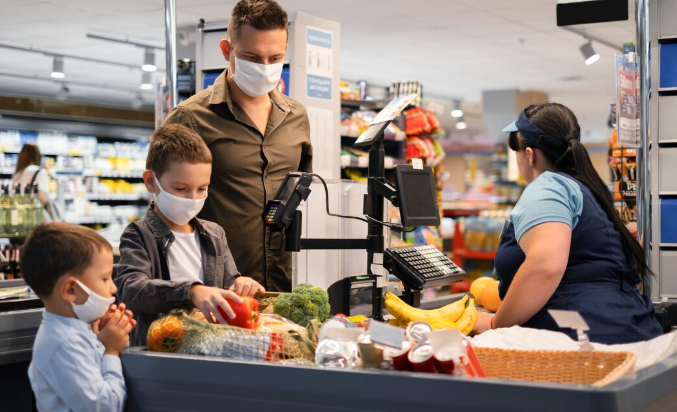
The grocery store appears to be a normal place on a normal weekday afternoon. A child swings their legs while sitting in the shopping cart. A carton of eggs is examined as though it held a crucial secret. A cashier scans frozen dinners, cereal boxes, and apples. However, this commonplace environment is beginning to resemble something completely different—a calm setting where discussions about public policy are taking place in real time.
It’s possible that very few people consider government policy when they enter a supermarket. The majority of consumers merely look at costs, contrast brands, and determine how much they can afford that week. But as the scene develops, it becomes increasingly apparent that supermarket aisles have transformed into living classrooms, illuminating the complex interrelationships between public policy, education, and economics.
| Category | Details |
|---|---|
| Topic | Grocery Stores as Public Policy Learning Spaces |
| Key Areas | Food access, education, economic policy |
| Relevant Research | “The Supermarket Study” on learning environments |
| Key Institutions | Brookings Institution, food policy research centers |
| Core Policy Issue | Food affordability and access |
| Social Impact | Community learning, childhood development |
| Economic Context | Rising grocery prices and food inflation |
| Public Policy Debate | Public grocery stores vs private retail |
| Educational Insight | Informal learning outside classrooms |
| Reference Website | https://www.brookings.edu |
Think about the straightforward act of purchasing milk. Global supply chains, agricultural subsidies, transportation expenses, and retail competition are all reflected in a gallon stored in a refrigerated case. Although the price tag may appear unremarkable, it conceals a whole ecosystem of policy options. And families quickly learn the lesson when that price suddenly increases.
This awareness has been heightened by food inflation. Grocery bills have been steadily rising for many households in recent years. In some places, coffee up to thirty percent. Beef moving into awkward situations. Families who are already juggling childcare, rent, and gas expenses find that the grocery store checkout line suddenly feels more like an economics lecture than a simple errand.
It’s difficult to ignore how people are pausing longer than they used to when strolling down the produce aisle. They do a thorough price comparison. They substitute less expensive ingredients for fresh ones. These minor choices, such as selecting store brands over well-known labels or completely avoiding some items, show how financial constraints affect day-to-day behavior.
Experts in public policy have started to focus on these everyday occurrences. The idea that supermarkets can turn into unexpected learning environments has been studied by policy and education groups. In one experiment, parents were encouraged to discuss food origins, numbers, and language with their children by placing simple signs in grocery aisles. More conversations between parents and children were sparked by something as simple as asking kids to identify products that come from cows near the milk section.
It had an unexpectedly powerful effect. When the signs came up, families talked to their kids more, particularly in areas with fewer educational resources. As the findings came to light, researchers started to view supermarkets as everyday settings where learning occurs organically rather than merely as retail establishments.
It’s difficult to ignore the concept’s elegance. Of course, schools continue to be very important. However, children only spend a small portion of their waking time in classrooms. The remainder takes place in sidewalks, parks, laundromats, homes, and grocery stores. Communities’ perspectives on education may change if those commonplace locations are transformed into unofficial learning spaces.
Meanwhile, supermarkets are now at the center of a different kind of policy discussion: access. Supermarkets have completely vanished in certain neighborhoods, especially those with low incomes. This phenomenon, which is frequently referred to as “food deserts,” forces locals to rely on pricey and limited convenience stores. Proposals for government-sponsored food hubs or publicly owned supermarkets have been spurred by this reality.
The concept is still debatable. Proponents contend that public supermarkets could ensure access to wholesome food and stabilize prices. In markets already dominated by private chains, some question whether government-run supermarkets could function effectively. It seems like food retail is gradually being viewed as infrastructure, more akin to utilities than regular business, as the debate progresses.
In the meantime, consumers keep pushing carts past cereal and canned soup shelves, frequently oblivious to the connection between their everyday excursion and national policy debates. Decisions regarding international trade, labor, transportation, and agriculture are reflected in every product. All of that complexity is condensed into a checkout counter and a few aisles at the grocery store.
Additionally, there is a subtle democratic quality to that setting. Supermarkets bring almost everyone together, unlike academic conferences or government hearings. Parents balancing young children. Senior citizens looking at coupons. After school, teenagers are grabbing snacks. Directly on a price label, public policy rarely feels abstract.
Observing this process makes it evident that supermarkets hold a unique position in public life. Despite being private companies, they are situated at the nexus of economic, educational, and health policy. A supermarket receipt is one of the few places where the effects of policy decisions are immediately apparent.
One gets the impression that this insight is just starting to form. More research is being done by policymakers on food access. Teachers are trying to figure out how to turn ordinary areas into classrooms. Whether grocery stores should be considered public infrastructure is a topic of discussion in communities.
The typical sounds of business, such as shoppers comparing prices under fluorescent lights, refrigerators humming softly, and shopping carts rolling across tile floors, continue to fill the aisles for the time being. However, there is something more educational hidden beneath that well-known rhythm.
It turns out that one of society’s most illuminating classrooms might be the grocery store. Not because it intentionally imparts lessons, but rather because it subtly reveals the ways in which everyday life, economics, and policy interact in ways that people can sense right away. It’s getting more difficult to ignore the lessons that are being taught between the dairy case and the bread aisle.

Follow Live Media News on Google News
Get Live Media News headlines in your feed — and add Live Media News as a preferred source in Google Search.
Stay updated
Follow Live Media News in Google News for faster access to breaking coverage, reporting, and analysis.
- Search any trending topic on Google (for example: Greece news).
- On the results page, find the Top stories section.
- Tap Preferred sources and select Live Media News.