


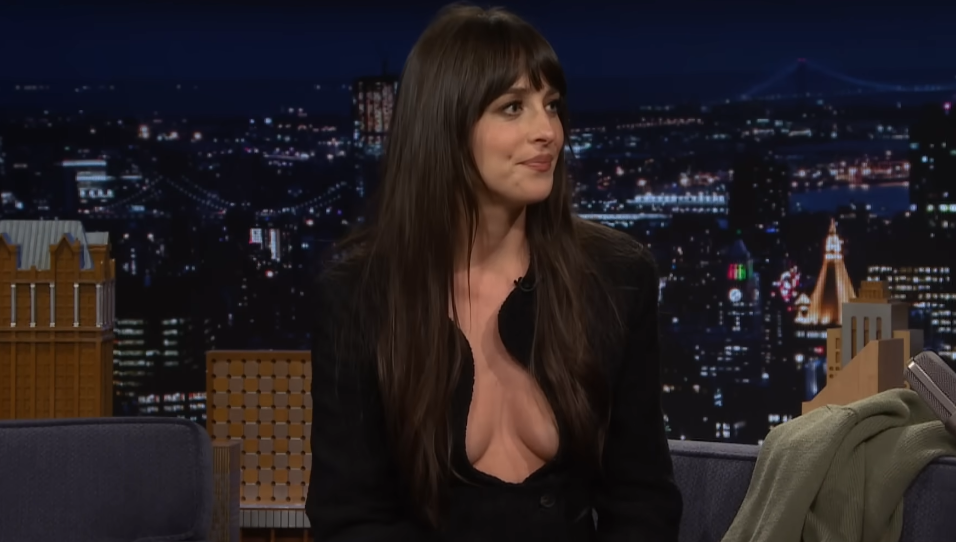
The advertisement opens inside a home that appears to be inhabited by a real person, complete with warm wood, soft light coming in through tall windows, and the kind of lived-in green kitchen that Dakota Johnson showcased during an Architectural Digest tour years ago, apparently igniting a trend in interior design. She is talking to someone off camera about a script while sporting Calvin Klein underwear, completely unaffected by the fact that she is being filmed. She is then playing pool without a top.
Then she’s by the pool, a pomegranate covering her chest. Then, with The Hollies playing in the background, he sat on a piano while wearing only jeans. The entire duration is sixty seconds. Compared to most feature films released this spring, it has received more views, discussions, praise, criticism, and screenshots. Once more, Calvin Klein has created something that people are talking about nonstop.
| Subject | Dakota Johnson — Calvin Klein Spring 2026 Ad Campaign |
|---|---|
| Full Name | Dakota Mayi Johnson |
| Born | October 4, 1989 (age 36), Austin, Texas |
| Parents | Melanie Griffith and Don Johnson |
| Known For | Fifty Shades of Grey, The Bear, Madame Web, Gucci Bloom campaigns |
| Campaign | Calvin Klein Spring 2026 — Underwear & Denim |
| Campaign Director | Gordon von Steiner |
| Photographer | Kate Arizmendi (DoP) |
| Set Designer | Andy Hillman |
| Launch Date | March 9, 2026 |
| Soundtrack | “Long Cool Woman (In a Black Dress)” — The Hollies (1972) |
| Distribution | Global — CK retail, website, social platforms, out-of-home placements |
| Previous CK Icons | Kate Moss, Mark Wahlberg, Bad Bunny, Jeremy Allen White, Kendall Jenner |
| TV Ad Airings (30 days) | 38,218 nationally aired commercial spots |
| Reference Website | AdWeek.com |
After all, that’s the whole point. In essence, Calvin Klein’s advertising history is a master class in persistent provocation, the kind that approaches the boundary of what is appropriate at any given cultural moment and then veers just a little bit over it—not enough to fall, but enough to draw attention. It all began in 1980 when fifteen-year-old Brooke Shields delivered a line about what stands between her and her Calvins, which simultaneously caused a great deal of controversy and huge sales.
The campaign taught the brand something that it has never forgotten: discomfort is incredibly beneficial for business when it is linked to sincere desire. The formula hasn’t changed much in 46 years. The faces shift. The cultural setting changes. However, the underlying logic—a lovely person, a private setting, and the idea of freedom from all limitations save the garment itself—remains obstinately constant.
The Dakota Johnson advertisement is especially well-calibrated because of the particular ease of use it conveys. This is not the refined, slightly detached glamour of a conventional luxury campaign, where the product incorporates the aspirational gap between the viewer and the subject. Johnson navigates the shoot in a similar manner to a Tuesday afternoon at home: she is carefree, lighthearted, and unconcerned with how she appears from any one perspective.
Director Gordon von Steiner, who has previously collaborated with the brand, shoots everything with a loose style that seems intentional rather than accidental. The pomegranate moment is humorous despite being ridiculous. The scene at the pool table is self-assured enough to be truly remarkable. When considered collectively, the campaign more successfully conveys the brand’s stated goal of balancing subtle sensuality and cheeky humor than a press release might imply.
Johnson’s own interpretation of the work, presented in a statement, is not to be disregarded as typical campaign rhetoric, but to be taken seriously. She said that channeling that energy in conjunction with Calvin Klein’s visual language felt both unique and timeless. She described the sensation of being a woman alone at home—working, reading, existing—as something that can feel liberating and sensual on its own terms. She might just be saying what a press office wrote for her.
However, it’s also possible that she knew exactly what the advertisement was doing and decided to take part because the image of femininity it portrays is one that she genuinely supports—not performance or availability, but rather a woman who is at ease enough in her own skin to find a milk jug amusing and a piano seat that is truly appropriate. Even though it’s difficult to confirm from the outside, the distinction is important.
The campaign places Johnson in a lineage that includes Jeremy Allen White, whose shirtless campaign in 2024 briefly made Calvin Klein underwear the most talked-about item in America, Kate Moss in the 1990s, Mark Wahlberg before he was primarily known as a movie star, and Bad Bunny in cotton stretch briefs that created its own cultural moment.
Beyond their obvious aesthetic appeal, each of these decisions connected the brand to something greater than itself by capturing a particular cultural mood at a particular time. Johnson’s campaign coincides with a genuinely contentious and unresolved discussion about women’s bodies, autonomy, and the distinction between objectification and self-expression. It’s reasonable to wonder if the advertisement adds anything beneficial to the discussion or just takes its energy. Which reading will stick is still up in the air.
There’s a sense that Calvin Klein made the right decision at the right time with the right person after seeing the entire thing unfold, including the global launch, the social media reaction, the 38,000+ TV ads that aired in the first month, the Reddit threads, the Instagram reposts, and the people reenacting the pomegranate scene for reasons that reveal something intriguing about how audiences relate to campaigns they truly like.
Not because the underwear is particularly revolutionary or because Johnson is currently the most well-known actress, but rather because the combination of her unique energy, Von Steiner’s eye, and The Hollies playing over everything created something that felt, against all odds, genuinely uncontrived. That is not as common in advertising as it might seem.

Follow Live Media News on Google News
Get Live Media News headlines in your feed — and add Live Media News as a preferred source in Google Search.
Stay updated
Follow Live Media News in Google News for faster access to breaking coverage, reporting, and analysis.
- Search any trending topic on Google (for example: Greece news).
- On the results page, find the Top stories section.
- Tap Preferred sources and select Live Media News.