


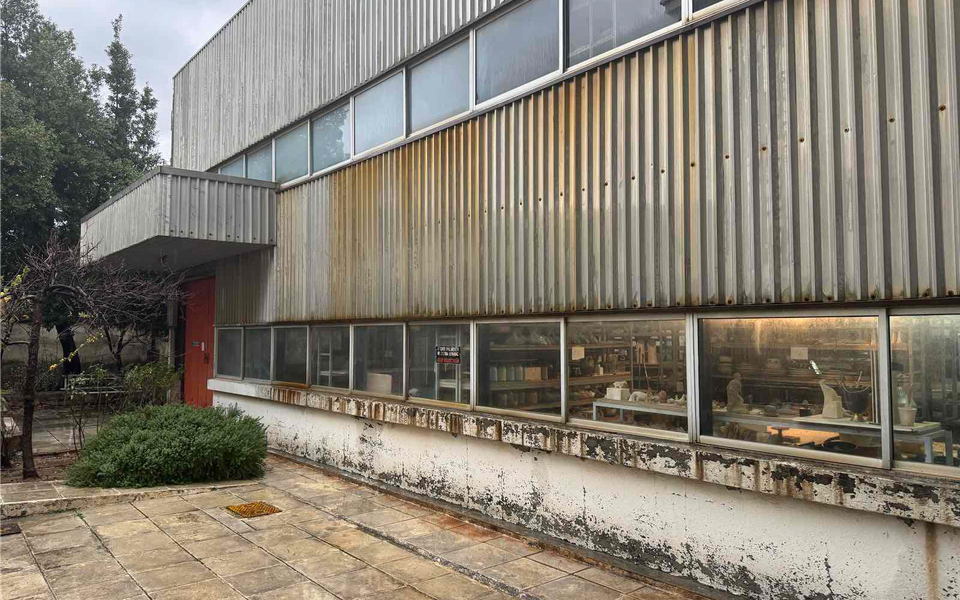
The Greek Ministry of Culture has unveiled plans to transform the historic workshop of pioneering ceramicist Eleni Vernadaki into a modern creative space for emerging artists. The ceramics workshop, located in the iconic Takis Zenetos building in Kantza, northeast of Athens, was recently acquired by the ministry along with all its equipment following the completion of a sustainability study.
Culture Minister Lina Mendoni presented the transformation study at a recent event, marking a new chapter for the Athens Design Center, which Vernadaki and her husband Nikos Papadakis established in 1968. The ministry’s acquisition aims to preserve both the architectural landmark and the pioneering ceramic art legacy developed within its walls over nearly five decades.
Preserving a Legacy of Ceramic Modernism
Eleni Vernadaki, now 93, spent approximately 50 years working in the Kantza facility after moving there in 1974. According to art historian Eugenia Alexaki, who collaborated with Vernadaki on a 2016 Benaki Museum publication, the space represents a “dynamic cell of artistic life.” The artist herself has described her work and the workshop as inseparable from one another.
The ceramicist is recognized internationally for transcending traditional boundaries between fine and applied arts, positioning herself at the center of European ceramic modernism. Her explorations of ceramic art concepts and the handmade artistic object have defined her creative trajectory throughout six decades of artistic production.
Historic Architecture Meets Contemporary Function
The workshop is housed in a rare example of 1970s industrial architecture designed by renowned architect Takis Zenetos. The building’s significance extends beyond its function as an artistic workspace, representing an important piece of Greece’s modern cultural heritage. Previously, the National Bank of Greece expressed interest in purchasing the property in 2008 to donate it to the Athens School of Fine Arts, though that initiative never materialized.
Additionally, the workshop’s architectural features have proven remarkably resilient. Despite challenges in recent years, the building’s infrastructure, including specialized lighting, ventilation systems, and material storage areas, remains largely functional according to the ministry’s assessment.
Revitalizing the Ceramics Workshop for Future Generations
According to Minister Mendoni, developing the Vernadaki workshop serves a dual purpose beyond mere preservation. The project aims to propagate the vibrant tradition of ceramic arts in Greece while simultaneously salvaging an important component of the country’s modern cultural heritage. The transformation will honor Vernadaki’s expressed wish that the fully equipped facility remain accessible to younger generations of creative artists.
The ministry’s sustainability study indicates that targeted interventions will focus on restoring the surrounding grounds to their original character. Meanwhile, the preservation of existing equipment and infrastructure will ensure continuity with the workshop’s historical function. The acquisition represents official recognition of the transformative work accomplished at the site during the second half of the 20th century, work that fundamentally redefined ceramic art in Greece.
However, the workshop’s importance extends beyond national boundaries. Scholars who have studied Vernadaki’s prolific body of work emphasize her contributions to European ceramic modernism more broadly. Her innovative approaches challenged conventional distinctions between artistic categories and expanded possibilities for ceramic expression.
The timeline for completing the transformation and opening the renovated ceramics workshop to young artists has not been publicly announced by the Culture Ministry. Further details regarding operational structure and access programs for emerging ceramicists are expected to be revealed as the project moves forward from the planning phase to implementation.

Follow Live Media News on Google News
Get Live Media News headlines in your feed — and add Live Media News as a preferred source in Google Search.
Stay updated
Follow Live Media News in Google News for faster access to breaking coverage, reporting, and analysis.
- Search any trending topic on Google (for example: Greece news).
- On the results page, find the Top stories section.
- Tap Preferred sources and select Live Media News.