


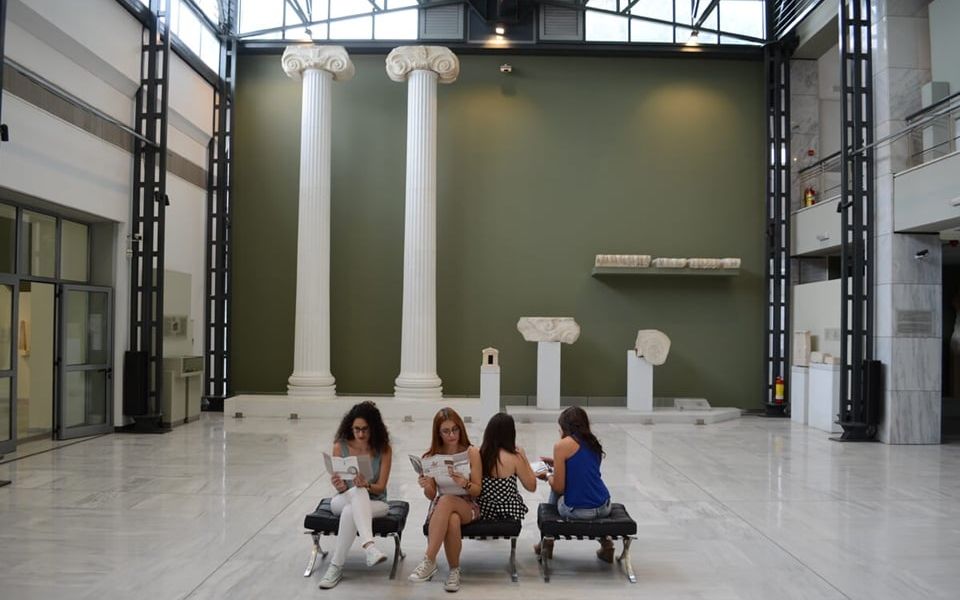
The Archaeological Museum of Kavala has become the focus of renewed scholarly attention following the publication of two comprehensive volumes examining the ancient Neapolis sanctuary dedicated to the goddess Parthenos. The sanctuary of the Virgin at ancient Neapolis, a city founded by Thasian settlers in the 7th century BC, continues to yield valuable insights into cult practices and architectural development in the ancient Aegean world.
The volumes, edited by Amalia Avramidou, associate professor of classical archaeology at the Democritus University of Thrace, were published in English by Brepols. According to the Athens-Macedonian News Agency, the publications examine ritual practices at the sanctuary and present extensive archaeological material from excavations that had remained largely unpublished for decades.
Ancient Neapolis Sanctuary Reveals Architectural Significance
Located on the rocky Panagia peninsula in what is today the old city of Kavala, the sanctuary served as a prominent landmark in antiquity. The site features Ionic columns and capitals from a 5th-century BC temple pavilion, now displayed in the Archaeological Museum of Kavala, which underscore the cosmopolitan character of ancient Neapolis.
Stavroula Dadaki, head of the Ephorate of Antiquities of Kavala, emphasized the sanctuary’s importance in regional archaeological studies. She noted that the site has long attracted scholarly attention due to its rich assemblage of Attic, Corinthian and Oriental pottery, as well as early evidence of Ionic temple architecture in a region where the Doric style typically prevailed.
Rare Examples of Ionic Temple Architecture
According to Dadaki, surviving archaic Ionic temples are relatively uncommon in Greece. The five-meter-high capitals and columns discovered at the ancient Neapolis sanctuary demonstrate the monument’s scale and are now used in educational programmes to illustrate the development of Ionic architectural forms.
The site can be compared with other significant sanctuaries including the Heraion of Samos and sanctuaries on Delos and Naxos. However, the Neapolis sanctuary provides unique insights into how Ionic architectural traditions were adopted in northern Greece during the archaic and classical periods.
Publication Places Sanctuary in Broader Academic Context
Dadaki said the publication of Avramidou’s research firmly places the sanctuary within broader academic discussions of ancient Greek sanctuaries and Aegean networks. The two volumes, titled “The Sanctuary of the Virgin in Ancient Neapolis. Engraved and Written Ceramic Inscriptions from the Sanctuary and Aegean Thrace” and “Ceramics, Stone Inscriptions and Small Finds,” provide comprehensive documentation of the site’s material culture.
Additionally, the publications highlight the sanctuary’s role as a political and commercial hub in the ancient Aegean. The diverse pottery assemblage suggests extensive trade connections across the Mediterranean world during the site’s period of use.
Early Archaeological Efforts Documented
Dadaki also highlighted the pioneering role of archaeologist Georgios Bakalakis, whose arrival in Kavala in 1933 initiated systematic efforts to gather scattered antiquities. Rescue excavations revealed a sanctuary with continuous use from at least the late 6th to the 4th century BC, according to the ephorate head.
Meanwhile, Bakalakis’ 1936 study “Neapolis – Christoupolis – Kavala” provided the first conclusive link between modern Kavala and ancient Neapolis. In contrast to earlier speculation, this work documented the city’s historical continuity through archaeological evidence.
The sanctuary of the Virgin offers an exceptional gateway to understanding the ancient world, Dadaki noted, with the collection of movable finds gathered over the years in the museum’s warehouses representing a large and important resource for ongoing research. The recent publications ensure that this material is now accessible to the international scholarly community for further study and analysis.

Follow Live Media News on Google News
Get Live Media News headlines in your feed — and add Live Media News as a preferred source in Google Search.
Stay updated
Follow Live Media News in Google News for faster access to breaking coverage, reporting, and analysis.
- Search any trending topic on Google (for example: Greece news).
- On the results page, find the Top stories section.
- Tap Preferred sources and select Live Media News.