


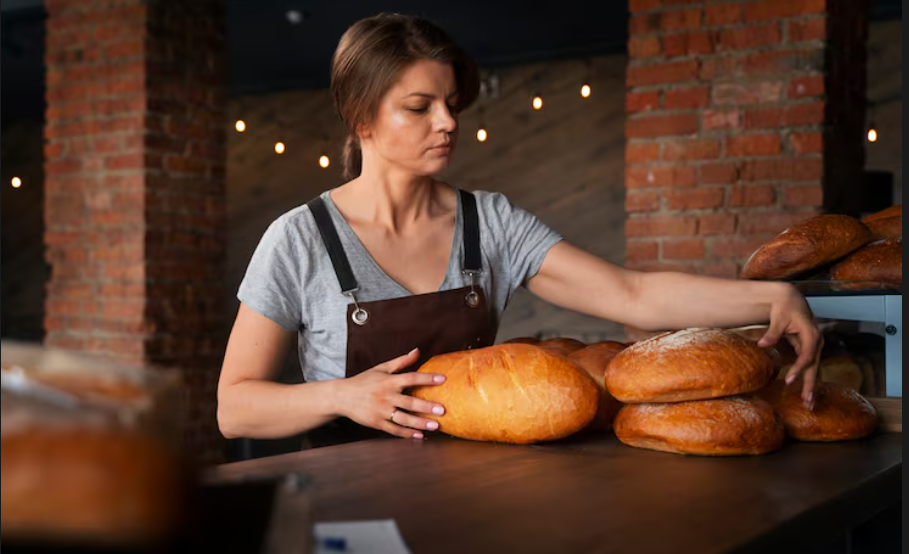
Before dawn, a certain kind of silence descends upon a bakery: the sound of ovens, the scent of something warm piercing the chill, and the dust of flour hanging in the air. Denis Maksimov is probably quite familiar with that. In the Moscow suburbs, he expanded Mashenka—named for his eldest daughter—into a three-location business. He kept the bread coming for eight years by paying a set annual tax, sometimes as little as tens of thousands of rubles. His tax bill skyrocketed by about 3,500% after the Russian government altered the regulations.
There is no typo in that number. Maksimov paid about $1,500 annually under the previous “patent” system. He is subject to a 5% value-added tax in addition to a 6% gross revenue levy under the new structure, which started to take effect in late 2025. According to reports, his monthly income fell from approximately $5,800 to just $2,000. It’s not ambitious to run three bakeries on that margin in one of the most expensive capital cities in the world; it’s practically impossible.
| Category | Details |
|---|---|
| Business Name | Mashenka Bakery |
| Owner | Denis Maksimov |
| Location | Suburban Moscow, Russia (3 locations in Moscow region) |
| Founded | Operating for at least 8 years under patent taxation system |
| Business Type | Small bakery chain |
| Annual Revenue (approx.) | Around 20–60 million rubles (~$261,000–$783,000) |
| Previous Tax Bill | ~$1,500/year (flat patent system) |
| New Tax Burden | 5% VAT + 6% gross income tax (effectively 3,500%+ increase) |
| Monthly Income Drop | From ~$5,800 to ~$2,000 post-reform |
| Notable Event | Appeared on Putin’s live call-in show, December 2024 |
| Government Response | Economy Minister Reshetnikov proposed temporary VAT exemptions |
| Current Status | Precarious survival; owner reversed closure plans temporarily |
| Reference Links | The New York Times – Russia Small Business Tax Reform / WTOP – Russia Economy Coverage |
What transpired next is the kind of tale that seems almost too obvious for a nation engaged in conflict with its own economic stability. In December, Maksimov made an appearance on President Vladimir Putin’s yearly televised call-in show.
He stood in front of his bakery and addressed the camera with the deliberate, measured desperation of someone who is fully aware of how unstable his position is. “We’re looking ahead without optimism, frankly speaking,” he said. “Many businesses will close down.” Putin nodded, listened, and pledged to investigate. The Kremlin received a basket of pies from the baker. Putin had tried them, the website boasted.
Mashenka was well-known for a few weeks. Clients arrived. Sales increased. Both the attention and the brief sense of relief were genuine. However, a tax code is not restructured by publicity. In the end, Economy Minister Maxim Reshetnikov suggested a few specific exemptions for Maksimov’s company, a tacit admission that it would be awkward to allow a baker who made an appearance on national television to go bankrupt. Whether that relief is long-lasting or just a patch used to halt the bleeding long enough for cameras to turn away is still unknown.
In a sense, this is the most accurate representation of the internal workings of Russia’s wartime economy. The financial burden is no longer theoretical four years after the full-scale invasion of Ukraine. Revenues from oil are declining. The deficit in the budget is growing. Once a major driver of economic growth, military spending has reached a plateau. When the Kremlin ran out of resources, it looked to regular Russians and their small businesses. There was a two percentage point increase in the VAT.
Previously exempting small operators from paying it, the revenue thresholds were lowered from 60 million rubles per year to 20 million this year, with plans to further reduce them to 10 million by 2028.
It is difficult to ignore the evidence when you stroll along Nevsky Prospekt in St. Petersburg, which has historically been one of Russia’s busiest commercial thoroughfares. Shuttered storefront after shuttered storefront was featured in recent social media videos; these images don’t need to be narrated. “I’ve never felt so scared as this year, so unprotected, so anxious,” stated Darya Demchenko, the owner of a chain of beauty salons in the city. Someone navigating a bump in the road wouldn’t use that language. Someone is observing the ground shift there.
The fact that Maksimov’s case attracted attention is what makes it unique. In Russia, the majority of small business owners will not participate in call-in shows. The president will not eat their pies. They will just quietly close, and the vacant storefront will become one of the others. In response to the new VAT structure, suppliers have increased their own prices by amounts that frequently surpass the official 2% increase.
As a result, costs are passed down the chain until they pool at the bottom, where the smallest operators have nowhere to send them. This time, there isn’t a pandemic-era relief fund. There is no large-scale discussion of a government backstop.
When the first round of new tax payments is due in April 2026, experts monitoring the situation speculate that it may finally act as a pressure valve. Entrepreneurs are going to learn what they owe if they haven’t already. Some will reduce their size. Some will shift their operations completely out of the taxed sector, off the books, and into the grey economy. Some will just give up.
For the time being at least, Mashenka is likely to survive. Because of the attention it garnered, the government made a sort of involuntary commitment; allowing it to fail in public would reveal the boundaries of Putin’s promised intervention. However, it is not a policy to survive by exception. There are thousands of other bakers, salon owners, and store owners who will never get their faces on television for every Denis Maksimov who did. Even before the ovens have cooled, they are quietly doing the math.

Follow Live Media News on Google News
Get Live Media News headlines in your feed — and add Live Media News as a preferred source in Google Search.
Stay updated
Follow Live Media News in Google News for faster access to breaking coverage, reporting, and analysis.
- Search any trending topic on Google (for example: Greece news).
- On the results page, find the Top stories section.
- Tap Preferred sources and select Live Media News.