


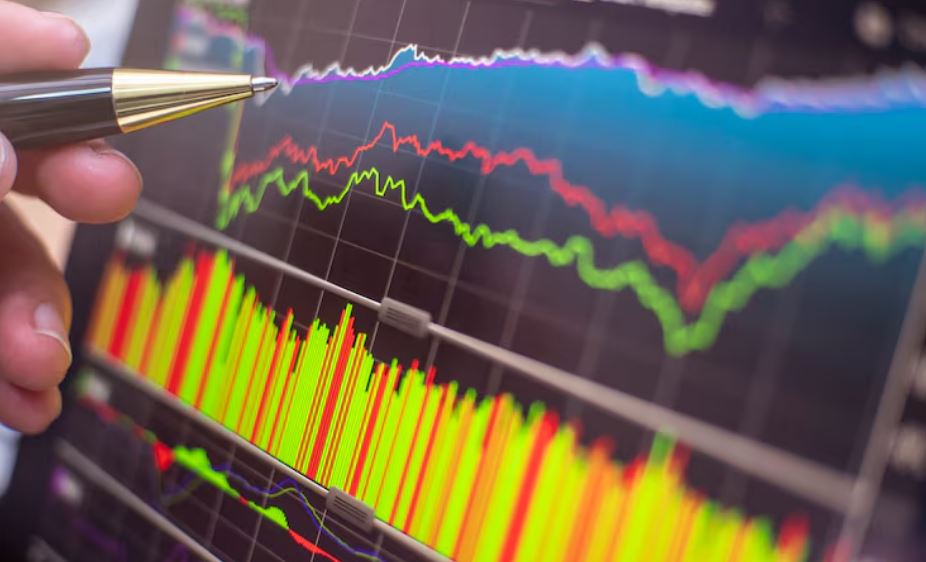
The New York Stock Exchange’s trading floor still has a distinct rhythm to it, with traders leaning in, screens flickering, and conversations barely audible over the din of activity. The Dow Jones Industrial Average is located somewhere above everything, resembling a scoreboard. updating silently. watched all the time.
At 46,225, the Dow doesn’t appear to be in danger. It remains close to historically high levels. However, the recent decline—more than 700 points in a single session—has created a new atmosphere. Not quite panic. Something more like discomfort.
| Category | Details |
|---|---|
| Name | Dow Jones Industrial Average |
| Common Name | Dow Jones / The Dow |
| Founded | 1896 |
| Number of Companies | 30 Major U.S. Companies |
| Current Level | ~46,225 |
| 52-Week Range | 36,611 – 50,512 |
| Operator | S&P Dow Jones Indices |
| Country | United States |
| Market Type | Stock Market Index |
| Reference Website | https://www.dowjones.com |
It’s possible that the environment surrounding the companies has a greater influence on the Dow’s movements than the companies themselves. The inflation data was higher than anticipated. Geopolitical tensions caused a sharp increase in oil prices. Additionally, the Federal Reserve sounded cautious—possibly more cautious than investors had anticipated—while maintaining stable interest rates.
As this develops, it seems like markets are looking for clarity but aren’t finding it. Despite its age, the Dow Jones continues to serve as a sort of emotional gauge. Only thirty businesses are tracked, including Microsoft Corp., Visa Inc., and McDonald’s, but those businesses have significant symbolic value. It feels more expansive than just numbers when they fall.
And a lot of them have been under pressure lately. Higher interest rates typically have a negative impact on stocks, particularly those that depend on future growth. Rising energy prices also have a knock-on effect on the economy, subtly raising costs for both consumers and businesses. Whether this combination will result in a short-term correction or a longer-term one is still unknown.
Uncertainty is disliked by the market. There is an abundance of it at the moment.
The direction of the Dow frequently determines the day’s mood at a specific time, right after the opening bell. A good start can improve mood in international markets. The opposite can be done by a weak person. Traders appeared cautious rather than reactive on a recent morning when the index opened close to 46,900 before declining. Orders moved, but they weren’t urgent.
That reluctance is instructive. The Dow has fared much worse in the past. It has endured financial crises, wars, and recessions. A few hundred points might not seem like much in comparison to those events. However, markets are about expectations as much as size. Additionally, expectations feel uneasy right now.
Investors appear to think that the Federal Reserve will play a major role in the next move. Will rates remain high for longer than expected? Will inflation continue to be obstinate? These issues loom over the market, influencing choices in ways that aren’t always apparent on a graph.
Beneath the surface, a change is also taking place. Technology-heavy indices, such as the Nasdaq, have dominated news for years due to companies involved in digital platforms and artificial intelligence. In contrast, the Dow feels almost conventional—diversified, industrial, and less ostentatious. However, it still matters, maybe because it represents a more realistic view of the economy.
Payments, consumer goods, and factories. tangible items. The difference between the Dow and more speculative assets is difficult to ignore. The Dow moves with a sort of grounded logic, while tech stocks soar on new narratives and cryptocurrencies swing wildly. That’s the impression, at least.
However, even that perception is under scrutiny. The index has fallen below some technical levels as a result of the recent decline, including long-term averages that traders keep a close eye on. The next support, according to some analysts, might be around 45,000. Some contend that the underlying economy is still robust enough to stop a further decline.
Both points of view are valid. The Dow seems to be torn between two forces: pressure and resilience. Strong corporate profits and consistent consumer demand on the one hand. Conversely, growing expenses, geopolitical threats, and monetary contraction.
Sentiment comes next. constantly changing. The movements of markets are not linear. They accelerate, reverse, and pause. The Dow is no different, even though it is known for being stable. It is evident that confidence is brittle and susceptible to new information, headlines, and anxieties when one day it falls precipitously and the next it rises.
The index nevertheless maintains its position. That has an almost symbolic quality. The Dow represents people’s perceptions of the state of the economy at any given time and is more than just a gauge of stock prices. It is raised by optimism. It is pulled down by doubt.
It appears to be balancing both at the moment. It’s unclear if the next move will be upward or downward. However, the issues that are causing it—inflation, interest rates, and international stability—won’t go away anytime soon. And the Dow will continue to move in that recognizable, somewhat erratic manner as long as those questions are not answered.

Follow Live Media News on Google News
Get Live Media News headlines in your feed — and add Live Media News as a preferred source in Google Search.
Stay updated
Follow Live Media News in Google News for faster access to breaking coverage, reporting, and analysis.
- Search any trending topic on Google (for example: Greece news).
- On the results page, find the Top stories section.
- Tap Preferred sources and select Live Media News.