


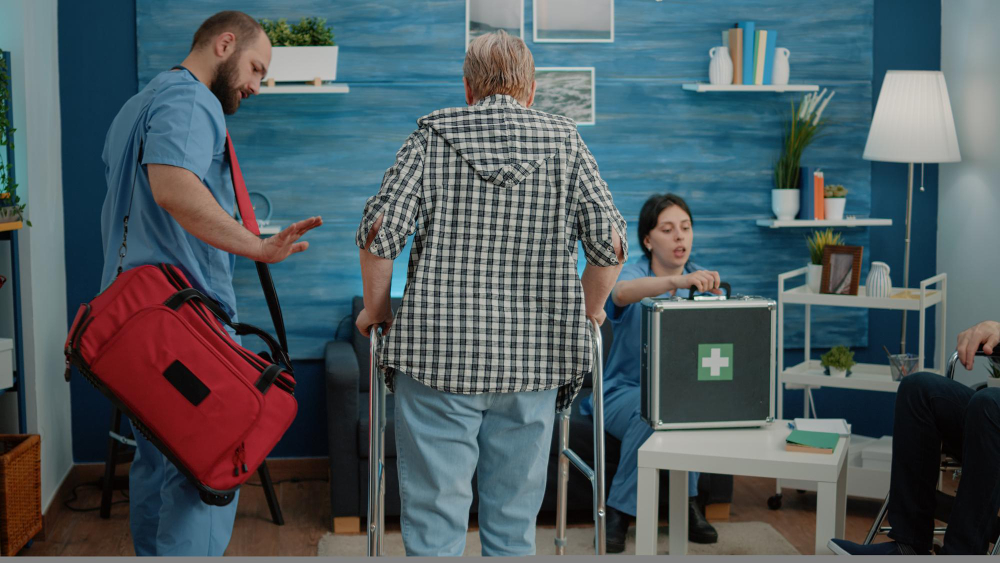
A woman in her late fifties is taking care of her medications, making a soft breakfast, helping her mother get dressed, making two phone calls to reschedule a doctor’s appointment, and mentally keeping track of three different prescription refills on a Tuesday morning that began at 5:45 a.m. in a Detroit suburb—all before the majority of her neighbors have had coffee. For the next few years, she will perform a variation of this every day. She’s not a nurse. She doesn’t get paid. She is among the approximately 45 million Americans who work a second job in addition to or instead of their primary job, which is not recognized by the government.
In an effort to quantify this reality globally, the ILO released data in October 2024 that showed 748 million working-age individuals are not employed due to caregiving obligations. There are 708 million women among them. There are forty million men. The difference between 708 and 40 is not a statistical anomaly. It is a structural aspect of how the majority of societies have chosen—though never quite decided—to arrange the tasks necessary to keep people alive, fed, cleaned, medicated, and emotionally supported. Most of the time, the choice has been made by default: someone must do it, and that person is nearly always a woman.
| Category | Details |
|---|---|
| Topic | Unpaid caregiving — economic value, gender disparity, policy gap |
| Scale (U.S.) | 45+ million employees also serving as unpaid caregivers |
| Scale (Global) | 748 million people outside labor force due to care responsibilities (ILO, 2023) |
| Women Affected | 708 million women worldwide outside labor force due to care duties |
| Estimated Value of Unpaid Care Work | At least $11 trillion globally (9% of global GDP) |
| Hours Worked Daily (Global) | 16.4 billion hours per day in unpaid care work |
| Gender Gap | Women perform 76.2% of all unpaid care hours worldwide |
| Time Spent by Women (Daily Average) | 4 hours 25 minutes — vs. 1 hour 23 minutes for men |
| U.S. Family Caregivers (2009 estimate) | 60 million, providing care valued at $450 billion |
| Michigan Example (2024) | 1.33 billion hours of care provided; valued at $27 billion |
| Key Organizations | ILO, AARP, Oxfam, ActionAid, UN Women |
| ILO Resolution | June 2024 — first global tripartite agreement on decent work in the care economy |
| Reference Website | ILO – Care Economy |
It is truly hard to comprehend the financial scope of what these caregivers are doing without pay, benefits, or official GDP recognition. According to data from 64 countries, there are 16.4 billion hours of unpaid care work done every day worldwide, which is the same as two billion people working eight-hour shifts without getting paid. That labor would be worth at least $11 trillion a year, or about 9% of the world’s GDP, if it were valued at the minimum wage. Unpaid housework in Britain alone is valued at over £1 trillion annually, surpassing 60% of GDP and surpassing the entire non-financial corporate sector, according to calculations made by the UK’s Office of National Statistics. These are not insignificant figures disguised in terms of advocacy. They are measurements of real work being done on a daily basis that are structurally impossible for the standard economic measurement instruments to capture.
This story’s American component is especially tangible. According to LinkedIn research, over 45 million working Americans are also providing unpaid care for family members, a fact that is directly described as “the labor force propping up America’s healthcare system and economy.” In 2024, family caregivers in Michigan alone provided 1.33 billion hours of unpaid care, which AARP values at $27 billion. This money would otherwise have to be spent on professional services that the state’s healthcare system could not possibly afford. Without this covert subsidy, the current healthcare system would not be able to operate. It was not intended to operate without it.
The story becomes more complex and the injustice is most apparent in the gender dimension. Globally, women provide unpaid care for an average of four hours and twenty-five minutes every day. One hour and twenty-three minutes is spent by men. Over the previous fifteen years, that difference has been closing by less than a minute annually. According to the ILO’s 2019 estimate, it will take 209 years to close the gender gap in unpaid care time at that rate. Two-thirds of women in their prime working years, between the ages of 25 and 54, are not in the workforce due to caregiving obligations. The effects compound: women who cut back on paid work to care for others earn less over the course of their lives, save less for retirement, and are more susceptible to poverty as they age, frequently as a result of working for decades while the economy pretended nothing was going on.
The data from rural settings is even more striking. According to ActionAid’s research in Rwanda, men spend about 90 minutes a day providing unpaid care, while rural women typically spend at least five hours. The difference increases to six hours for women and less than an hour for men in Ghana. According to a 2017 field study conducted in Rwanda, a man’s normal day consists of working on the farm until noon, relaxing until two in the afternoon, drinking beer and chatting until eight, and then going to bed. In the same village, a woman’s day began at 5:30 a.m. and continued uninterrupted until 8:30 p.m. The same community provided both descriptions. It wasn’t a secret either.
It’s difficult to ignore the fact that practically no one has truly found a solution to this issue, which is one that everyone acknowledges. The first international tripartite agreement on the subject, the ILO’s June 2024 Resolution on Decent Work and the Care Economy, recognized that caregiving obligations put “structural barriers” in the way of women entering the workforce and advocated for laws that shift care from households to states through public services. The language was powerful. The financial pledges were not as strong. The dynamic that exacerbates this situation is being accelerated by the aging of populations in high-income countries: an increase in the number of people in need of care, a decrease in the number of younger family members available to provide it, and a formal care workforce that is unable to meet the demand at any reasonable cost. The Detroit suburban woman is not an exception. She is a sneak peek.

Follow Live Media News on Google News
Get Live Media News headlines in your feed — and add Live Media News as a preferred source in Google Search.
Stay updated
Follow Live Media News in Google News for faster access to breaking coverage, reporting, and analysis.
- Search any trending topic on Google (for example: Greece news).
- On the results page, find the Top stories section.
- Tap Preferred sources and select Live Media News.