


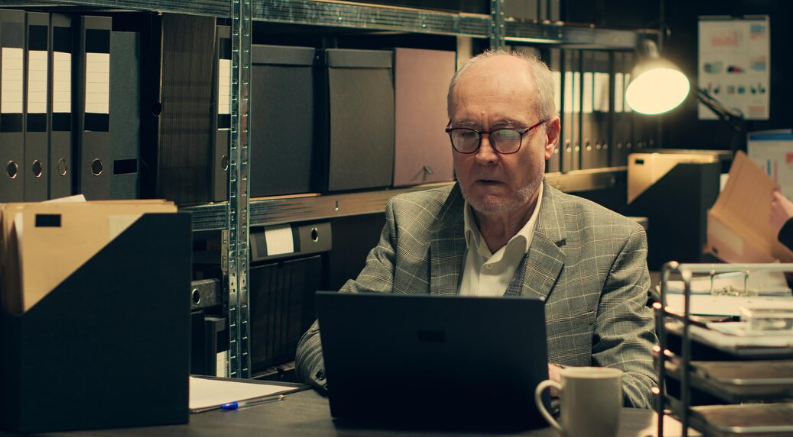
You can see the scope of the issue before anyone even speaks to you when you walk into an EFKA office in central Athens on a Tuesday morning. Three feet of folders. Radiators are pressed up against cardboard boxes. A clerk searching through a 1994 file for a stamp that might or might not be there. Greek patience has long died in the Single Social Security Entity, and for many years it appeared that nothing short of fire could save it.
There’s a new plan now. The government intends to use scanning to get out of this mess. According to official estimates, over 1.4 billion pages will be digitized over the course of the next three years, encompassing paper archives that presently take up about 152,000 square meters across ministries, courts, urban planning departments, and EFKA itself. That’s about the size of a small neighborhood, give or take. When you consider that each of those pages must be physically lifted, the number almost seems absurd.
| Project Profile | Details |
|---|---|
| Project Name | EFKA Digital Archive & Public Sector Digitization Initiative |
| Lead Agency | Single Social Security Entity (EFKA) |
| Overseeing Ministry | Ministry of Digital Governance, Greece |
| Key Figure | Kyriakos Pierrakakis, Minister of State and Digital Governance |
| Implementation Body | Information Society S.A. (Koinonia tis Pliroforias) |
| Project Scope | More than 1.4 billion pages |
| Physical Storage Replaced | Approx. 152,000 square meters of paper archives |
| Funding Source | EU Recovery and Resilience Facility |
| Estimated Timeline | Three years from launch (2023 onwards) |
| Sectors Covered | EFKA, Ministries, Urban Planning, Courts |
| Public Service Platform | Gov.gr digital portal (1,500+ services) |
| Goal | End paper-based bureaucracy in public sector |
The minister of digital governance, Kyriakos Pierrakakis, who has become somewhat of a mainstay in discussions regarding Greek modernization, has been direct about the disparity. According to him, the Greek state has not yet mastered paper, and a significant portion of funds from the EU Recovery Fund are being used specifically to turn it into information. Speaking with those who frequently deal with EFKA gives me the impression that they will believe it when they see it. Greeks are familiar with digital promises.
This time, though, something does feel different. More than 1,500 services are now available on the Gov.gr platform, and routine tasks that previously required waiting in line for half a day, receiving the incorrect queue number, and being sent home for a missing photocopy can now be completed over the phone. That is not insignificant. The steps needed for a public university to obtain stationery were famously counted in a 2019 Aristotle University study. Forty. for writing instruments.
But the more difficult case is EFKA. It bears the burden of decades’ worth of disjointed pension funds, contradictory rules, court rulings, and the kind of institutional memory that is limited to a particular third-floor filing cabinet. In a 2021 working paper, the IMF characterized the pension system as expensive, complicated, and distorted, pointing out that attempts at reform frequently failed due to judicial opposition and special interests. The design flaws cannot be fixed by digitizing the paperwork alone. However, it makes them visible, and reform usually starts with visibility.
Contrary to popular belief, the technical work is more complex. The simple part is scanning. Metadata—the keywords and tags that enable a document to be located six months later by someone who is unaware of its existence—is the more difficult task. CEO of the Information Society Stavros It is difficult to argue against Asthenidis’ framing of this as a prerequisite for true digital governance. A scanned page is simply a heavier type of paper that no one can search for.
The more intriguing question is what happens if it succeeds. Nowadays, Greek pensioners—many of whom are elderly—spend hours or even days trying to resolve problems that only arise because a record of contributions from 1987 is somewhere in a basement. Reducing that to minutes would alter a basic aspect of the citizen-state relationship. The trauma of the crisis years and the resentment resulting from the 2012 haircut that destroyed €25 billion in pension fund holdings would not be erased. However, it may ultimately mean that entering a public office is no longer a punishment.
It is still genuinely unclear whether the project succeeds or subtly falls into the long Greek tradition of unfinished reforms. The funds are present. There seems to be political will. Yes, the paper is there. All that’s left is the tedious, laborious process of lifting one page at a time and transforming it into a computer-readable format. Elections are not won by this kind of thing. But it could be the kind of thing that finally stops one Greek grandmother from crying in a waiting area.

Follow Live Media News on Google News
Get Live Media News headlines in your feed — and add Live Media News as a preferred source in Google Search.
Stay updated
Follow Live Media News in Google News for faster access to breaking coverage, reporting, and analysis.
- Search any trending topic on Google (for example: Greece news).
- On the results page, find the Top stories section.
- Tap Preferred sources and select Live Media News.