


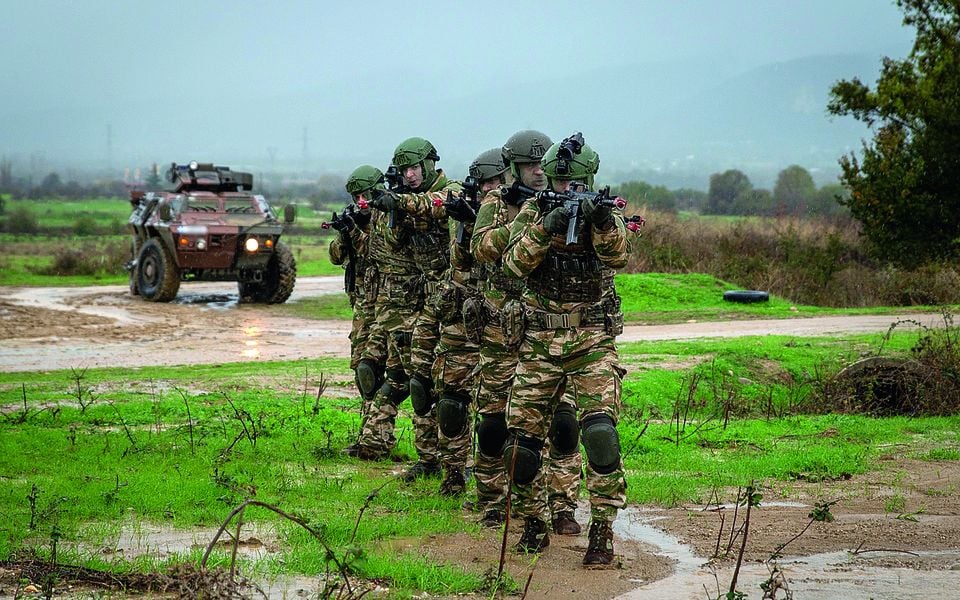
Greece plans to contribute a specialized battalion to the International Stabilization Force in Gaza, marking a significant expansion of its peacekeeping role in the region. The deployment will include 100-150 personnel equipped with armored vehicles for security operations, along with medical staff and engineers, according to recent reports. This represents an upgraded mission compared to Greece’s previous international engagement in Afghanistan under the International Security Assistance Force from 2002 to 2021.
The Greek contingent will operate within the security perimeter established by Israeli Defense Forces in Gaza. Two Greek officers have already been assigned to the US-led Civil-Military Coordination center in the southern Israeli city of Kiryat Gat, though the exact deployment date for the full force has not been determined.
Enhanced Security Role for Greek Forces
The security component of the Gaza peacekeeping mission represents a notable shift in Greece’s international military engagement strategy. The battalion will likely utilize M1117 armored security vehicles, similar to those employed by US military police forces. This marks a departure from Greece’s previous humanitarian-focused operations in Afghanistan, where Greek personnel primarily distributed medical supplies, assisted in reconstruction efforts, and cleared minefields.
Additionally, the mission aligns with the Greek government’s stated objective to assume a more active role in crisis management, particularly within its immediate geographic vicinity. The decision came after extensive consultations with both the United States and Israel to determine the appropriate composition and operational parameters for Greek forces.
International Framework and Support
The Gaza Stabilization Force operates under the framework of the peace plan agreed upon by Hamas and Israel last October. United Nations Security Council Resolution 2803, passed on November 17, provided the official mandate for the international peacekeeping operation.
Greece was among the first nations to endorse the US proposal for establishing the stabilization force, a decision that earned acknowledgment from Washington. However, the government faced internal opposition regarding the potential risks to Greek personnel in the conflict zone.
Coalition Structure and Expansion Plans
The Greek battalion will form part of an initial 8,000-strong force under the command of US Central Command. Egypt and Israel, as countries bordering Gaza, will also contribute significantly to the peacekeeping operation. Meanwhile, the force is expected to expand to approximately 20,000 personnel, following a model similar to the International Security Assistance Force in Afghanistan, though on a considerably smaller scale than ISAF’s peak strength of 180,000 troops.
In contrast to fully staffed battalions, the Greek contribution will operate at partial strength but with enhanced capabilities. The security element, though relatively small, will be integrated into larger multinational formations to maximize operational effectiveness.
Strategic Implications for Regional Stability
The International Stabilization Force in Gaza represents a critical component of broader efforts to maintain security and facilitate reconstruction in the territory. Greece’s participation demonstrates its commitment to Mediterranean security and strengthens its strategic partnership with the United States and Israel.
Furthermore, the mission provides Greece with an opportunity to demonstrate its capabilities in modern peacekeeping operations that combine traditional humanitarian assistance with active security responsibilities. This dual-role approach reflects evolving international peacekeeping standards in complex post-conflict environments.
The timeline for full deployment of the stabilization force remains unclear, with operational planning continuing among contributing nations. Authorities have not confirmed specific dates for when Greek forces will arrive in Gaza, though preparatory coordination is already underway through the officers stationed in Kiryat Gat.

Follow Live Media News on Google News
Get Live Media News headlines in your feed — and add Live Media News as a preferred source in Google Search.
Stay updated
Follow Live Media News in Google News for faster access to breaking coverage, reporting, and analysis.
- Search any trending topic on Google (for example: Greece news).
- On the results page, find the Top stories section.
- Tap Preferred sources and select Live Media News.