


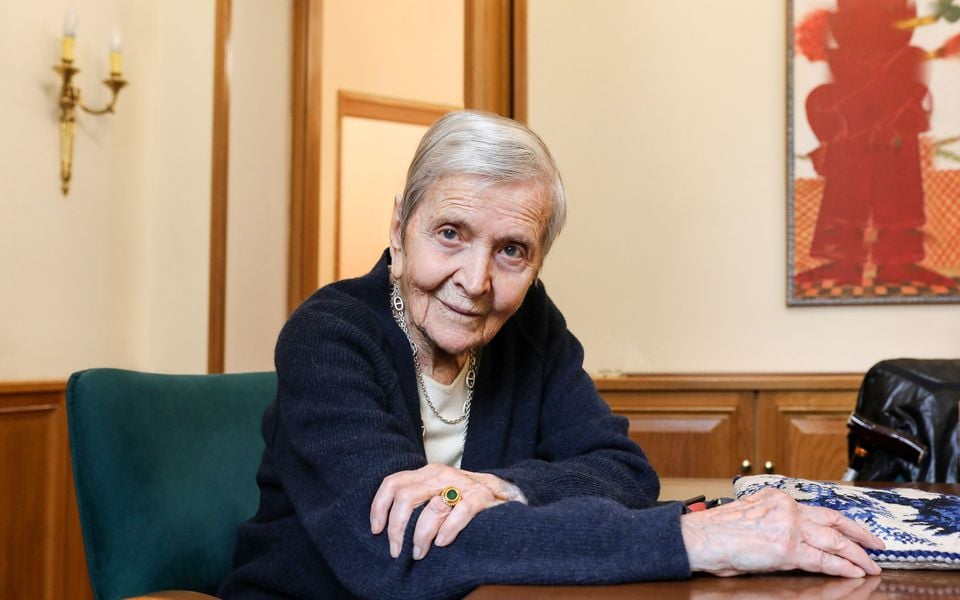
Eleni Glykatzi-Ahrweiler, the renowned Byzantine historian who became the first woman rector of Paris’ Sorbonne University, has died. The distinguished academic, who was born in Athens in August 1926 and shaped both Greek and French intellectual life for decades, passed away after a remarkable career spanning continents and disciplines. Her scholarly work in Byzantine studies remains a reference point for researchers worldwide, while her pioneering role at one of Europe’s most prestigious universities broke barriers for women in academia.
According to biographical accounts, Glykatzi-Ahrweiler’s parents were refugees from Prousa in Asia Minor. She grew up in modest circumstances in the Athens suburb of Vyronas, where six children shared a single room in a home without heating. Her early experiences during the German occupation and participation in the Resistance through EPON, the youth wing of the National Liberation Front, proved decisive in shaping her character, she later explained.
From Athens to Academic Excellence in Paris
In 1945, Glykatzi-Ahrweiler ranked 13th in entrance exams for the archaeology faculty of the University of Athens. After graduating in 1953, she moved to Paris when women had no access to Greece’s Archaeological Service. There she continued her studies at the École des Hautes Études, immersing herself in Byzantine poets, chroniclers, and historians while conducting intensive research on historical sources.
Her academic journey led to a groundbreaking dissertation on Byzantium and the sea, which she submitted in April 1964 while nine months pregnant. The following day, she gave birth to her daughter Marie-Hélène. Three years later, in 1967, she became a professor at the Sorbonne, navigating a competitive selection process where some colleagues opposed her candidacy simply because she was a woman or foreign-born.
Breaking Barriers as Sorbonne Rector
In 1976, Eleni Glykatzi-Ahrweiler achieved a historic milestone by becoming rector of the Sorbonne University, the first woman to lead the institution in its 700-year history. At the official reception, she made a bold statement by appearing in a yellow tuxedo, signaling her refusal to conform to traditional expectations. Throughout her tenure, she maintained direct contact with students and colleagues, beginning lectures early in the morning and devoting afternoons to administrative responsibilities.
Additionally, she balanced her demanding professional life with family commitments. She always returned home at noon to spend time with her husband Jacques Ahrweiler, a physical chemist she married in 1958, and their daughter. The couple had met in Paris intellectual circles that included poets Paul Éluard and Louis Aragon, and philosopher Simone de Beauvoir.
Byzantine Studies and Historical Philosophy
Her contributions to Byzantine history scholarship earned international recognition. In an interview with Kathimerini, she articulated her historical philosophy, stating that history reminds us of solutions chosen in similar situations but warning that “a history that teaches only one solution is dangerous.” This approach reflected her broader rejection of rigid categorizations and labels throughout her life.
Meanwhile, her political philosophy defied simple classification. She famously stated: “I am left wing because everything must pass through there, but also right wing because from there everything will be set right.” Her friendship with statesman Konstantinos Karamanlis exemplified her ability to transcend partisan divisions while maintaining intellectual independence.
Leadership in Greek Cultural Institutions
However, Glykatzi-Ahrweiler’s influence extended far beyond academic circles. In 1993, she became president of the European Cultural Center of Delphi, marking a decisive shift in focus toward her homeland. She also served as president of the National Theater of Greece among numerous other roles and distinctions, according to reports of her career achievements.
After her husband Jacques Ahrweiler died in 2010, she concentrated even more on Greek cultural affairs. She emphasized that her guiding principle throughout life was the ancient maxim “know thyself,” which she described as requiring tremendous effort to truly embrace. She admitted struggling with fears but determined never to let them overwhelm her or show them to family and colleagues.
Legacy of Determination and Excellence
In contrast to those who accepted limitations, Glykatzi-Ahrweiler counseled young people to remove the word “impossible” from their vocabulary. In a 2019 Kathimerini interview, she explained that everything she achieved came from never thinking something was impossible. She advised keeping “your feet on the ground and your gaze high,” noting that only humans among living beings can look to the sky.
Her life demonstrated this philosophy in action. From her childhood learning to read by listening to siblings, through her chess games on the rocks of the Herod Atticus Theater during university, to hosting dignitaries while preparing her own braised artichokes, she embodied intellectual rigor combined with warmth and authenticity. She conversed with heads of state and intellectuals while preserving family recipes from her mother, aunts, and grandmother.
The academic community and cultural institutions in both Greece and France are expected to honor Glykatzi-Ahrweiler’s memory with tributes celebrating her groundbreaking achievements. Details regarding memorial services have not yet been confirmed by authorities.

Follow Live Media News on Google News
Get Live Media News headlines in your feed — and add Live Media News as a preferred source in Google Search.
Stay updated
Follow Live Media News in Google News for faster access to breaking coverage, reporting, and analysis.
- Search any trending topic on Google (for example: Greece news).
- On the results page, find the Top stories section.
- Tap Preferred sources and select Live Media News.