


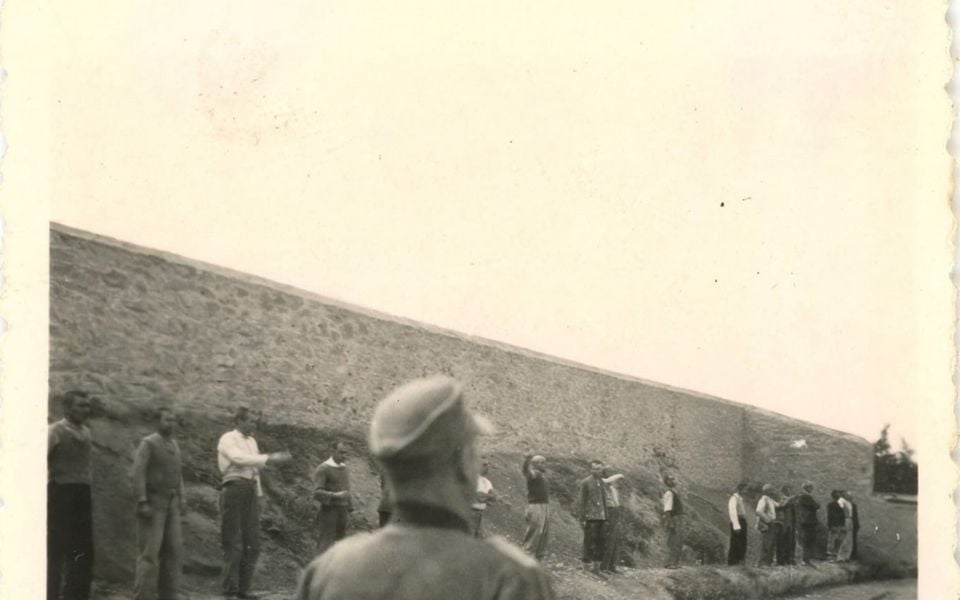
Greece’s Culture Ministry has dispatched experts to Belgium to examine photographs depicting the execution of 200 communists at Kaisariani on May 1, 1944, after the images appeared in an online auction. The ministry confirmed that specialists will travel to Ghent to assess the authenticity, legal provenance, and historical significance of the 12 photographs before determining acquisition procedures.
According to the ministry, the images are considered very likely authentic, though several legal complications surround any potential claim. The photographs surfaced recently on eBay, prompting swift action from Greek authorities to secure what could be crucial historical documentation of a World War II atrocity.
Assessment of Kaisariani Execution Photographs Underway
The Central Council of Modern Monuments is scheduled to review the collection on Wednesday, with discussions expected regarding the possible designation of the photographs as monuments. If authenticity and lawful origin are documented, the Culture Ministry stated it will immediately finalize measures for acquisition through appropriate legal channels.
Meanwhile, the Communist Party of Greece has contributed to verification efforts by identifying two individuals among the 200 victims using archival material from its Central Committee. According to 902.gr, research indicates one photograph likely shows 30-year-old Thrasyvoulos Kalafatakis alongside Dimitris Papadopoulos, based on comparison with archival photographs and biographical details from a 2016 publication.
Technical Challenges in Verification Process
Historian Tassos Sakellaropoulos, head of historical archives at the Benaki Museum, outlined the complex verification process required for the Kaisariani photographs. Assessment involves examining both material characteristics of the photographs as physical objects and stylistic and technical details of the images themselves.
However, identifying depicted individuals presents significant challenges, particularly because close relatives of the 200 executed are no longer alive. Sakellaropoulos noted that the victims had been imprisoned for three and a half years before their execution, raising uncertainty about how many photographs of them even exist.
Additionally, post-war research to identify the victims’ names was conducted with great difficulty because they were communists and their execution remained taboo for many years. The political climate following World War II complicated documentation efforts that might otherwise have preserved more detailed records.
Historical Significance and Modern Technology
Sakellaropoulos emphasized that technological advances now allow for more definitive identification of depicted persons, noting that absolute certainty in authentication requires recognizing the individuals shown. He described the profound impact of the photographs, stating that the great shock comes not from text or seals, but from the faces themselves.
In contrast to written documentation, the photographs represent what the historian called “the rescue, beyond the barbarity, of life’s moment.” This characterization underscores the unique historical value these images could provide in documenting the Kaisariani massacre and preserving the memory of its victims.
Vandalism at Memorial Site
Separately, unknown vandals damaged the marble plaque at the Kaisariani memorial honoring the 200 victims, according to the report. The incident occurred around the same time the auction photographs came to public attention, though authorities have not confirmed any connection between the two events.
The Culture Ministry has not announced a specific timeline for completing the authentication process or finalizing acquisition procedures. Officials will first need to receive the expert assessment from Belgium before determining next steps regarding the photographs’ legal status and potential transfer to Greek state custody.

Follow Live Media News on Google News
Get Live Media News headlines in your feed — and add Live Media News as a preferred source in Google Search.
Stay updated
Follow Live Media News in Google News for faster access to breaking coverage, reporting, and analysis.
- Search any trending topic on Google (for example: Greece news).
- On the results page, find the Top stories section.
- Tap Preferred sources and select Live Media News.